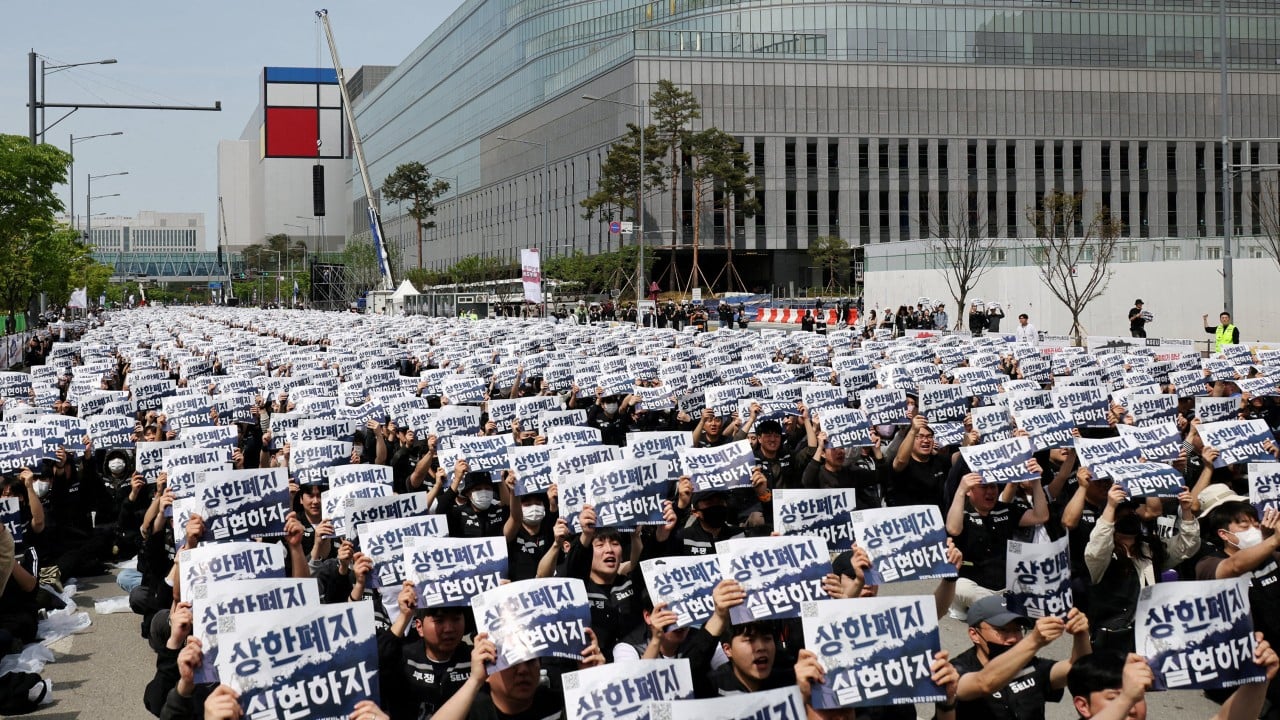
South Korea will use emergency arbitration to block a Samsung Electronics strike that could hit 25% of global memory chip supplies.
- South Korea will use emergency arbitration to block Samsung strike
- Samsung accounts for nearly a quarter of the world’s memory chips
- Wage talks restart Monday after months of deadlock
South Korea’s government is pulling out all the stops to prevent a strike at Samsung Electronics, the country’s largest employer and the world’s top memory chip producer. On Sunday, Prime Minister Han Duck-soo told reporters Seoul would pursue “all options,” including emergency arbitration, to keep the plants running. The move comes two days before Samsung and its main labor union resume pay talks with a government mediator after months of stalled negotiations. Samsung’s chips power everything from smartphones to data centers, so any disruption could ripple through global tech supply chains fast. Analysts say a strike could cost the company $1 billion a week in lost production alone. That’s why the government isn’t taking chances. “We’ll use every legal tool to prevent a strike,” Han said. “But we’re also preparing for the worst-case scenario.” The stakes are sky-high. Samsung makes about 25% of the world’s memory chips, and South Korea churns out over 60% of the global supply. A prolonged shutdown would leave tech giants scrambling for parts and drive up prices for everything from laptops to cloud servers. The union, which represents about 22,000 workers at Samsung’s chip plants, has been pushing for a 6% wage hike and better bonuses. Samsung offered 4%, a gap that’s left both sides dug in. The talks restart Monday with a government-negotiated mediator at the table, but neither side has blinked yet. Even if the mediator brokers a deal, the union’s rank-and-file still has to approve it—and they’re not guaranteed to follow the leadership’s lead. Last year, a similar mediation effort collapsed when workers rejected the terms. Samsung’s plants in Pyeongtaek and Hwaseong are on high alert. Security is tight, and contingency plans are in place to keep production running if talks fail. The company has already stockpiled extra chips and is testing backup suppliers in the U.S. and Europe. But those moves only go so far. Memory chips are made in weeks-long cycles, and even a few days of halted production can create shortages that ripple for months. The government’s emergency arbitration option would force both sides into a last-resort settlement, but it’s a risky play. Samsung’s management has historically resisted government interference in labor disputes, fearing it sets a bad precedent. The union, meanwhile, could see the move as an attack on its bargaining power. If arbitration fails, the union can still call a strike—though legally, it has to give 15 days’ notice first. That gives Samsung a short window to lock in alternative production or negotiate further. The clock is ticking. Samsung’s next quarterly earnings report drops in just over a month, and investors are already jittery. Any hint of a strike could spook markets and tank the stock. Analysts at Credit Suisse recently downgraded Samsung’s shares, citing “elevated labor risk.” The bigger picture? South Korea’s economy is deeply tied to its tech giants. Samsung alone makes up about 15% of the country’s exports. A prolonged disruption would hurt not just Samsung but the entire South Korean economy, which is already grappling with slowing growth and high household debt. The government’s aggressive stance shows how seriously it’s taking the threat. But whether its tactics work remains to be seen. For now, all eyes are on Monday’s talks—and the workers who hold the power to shut it all down.
What You Need to Know
- Source: SCMP
- Published: May 17, 2026 at 15:18 UTC
- Category: World
- Topics: #scmp · #asia · #china · #world-news · #politics · #government
Read the Full Story
This is a curated summary. For the complete article, original data, quotes and full analysis:
All reporting rights belong to the respective author(s) at SCMP. GlobalBR News summarizes publicly available content to help readers discover the most relevant global news.
Curated by GlobalBR News · May 17, 2026
Related Articles
- Czech beer consumption drops sharply as young drink less
- 🎉 250 Articles in World!
- WHO declares Ebola emergency as Congo outbreak spreads to Uganda
🇧🇷 Resumo em Português
O risco de uma greve na maior fabricante de chips de memória do mundo, a sul-coreana Samsung Electronics, levou Seul a acionar uma arbitragem emergencial para evitar prejuízos bilionários à indústria global de semicondutores. A medida, anunciada pelo primeiro-ministro da Coreia do Sul, ocorre em meio a tensões trabalhistas que ameaçam paralisar a produção em uma das plantas mais estratégicas do setor, responsável por abastecer desde smartphones até data centers.
O Brasil, embora não seja um grande produtor de chips como a Coreia, sente os impactos indiretos desse tipo de crise, já que depende de importações de componentes eletrônicos para setores como telecomunicações, automotivo e tecnologia. Uma interrupção na fabricação da Samsung poderia elevar os custos de importação e atrasar entregas essenciais para a indústria nacional, agravando ainda mais a inflação em produtos dependentes de chips. Para os consumidores brasileiros, o cenário pode se traduzir em aumentos de preços em eletrônicos e dificuldades para aquisição de itens como computadores e celulares.
A arbitragem deve ser concluída nos próximos dias, mas o episódio reforça a fragilidade das cadeias globais de semicondutores e a necessidade de o Brasil diversificar suas fontes de fornecimento para evitar vulnerabilidades futuras.
🇪🇸 Resumen en Español
El Gobierno surcoreano amenaza con intervenciones legales para evitar que una huelga paralice la mayor planta de semiconductores del mundo, propiedad de Samsung Electronics. El primer ministro de Corea del Sur ha anunciado que se recurrirá a un arbitraje de emergencia para frenar el conflicto laboral, tras la reanudación de las negociaciones entre la compañía y sus trabajadores.
La medida refleja la alta tensión en un sector clave para la economía global, donde Corea del Sur lidera la producción de chips de memoria. Samsung, proveedor esencial para gigantes tecnológicos como Apple y Nvidia, no puede permitirse interrupciones en un momento de fuerte demanda. Para los lectores hispanohablantes, especialmente en países con industrias tecnológicas dependientes de estos componentes, el desenlace de este conflicto podría influir en los precios y la disponibilidad de dispositivos electrónicos en los próximos meses.
SCMP
Read full article at SCMP →This post is a curated summary. All rights belong to the original author(s) and SCMP.
Was this article helpful?

Discussion