Keir Starmer must decide within 24 hours whether to step down as UK Prime Minister amid growing Labour Party challenges.
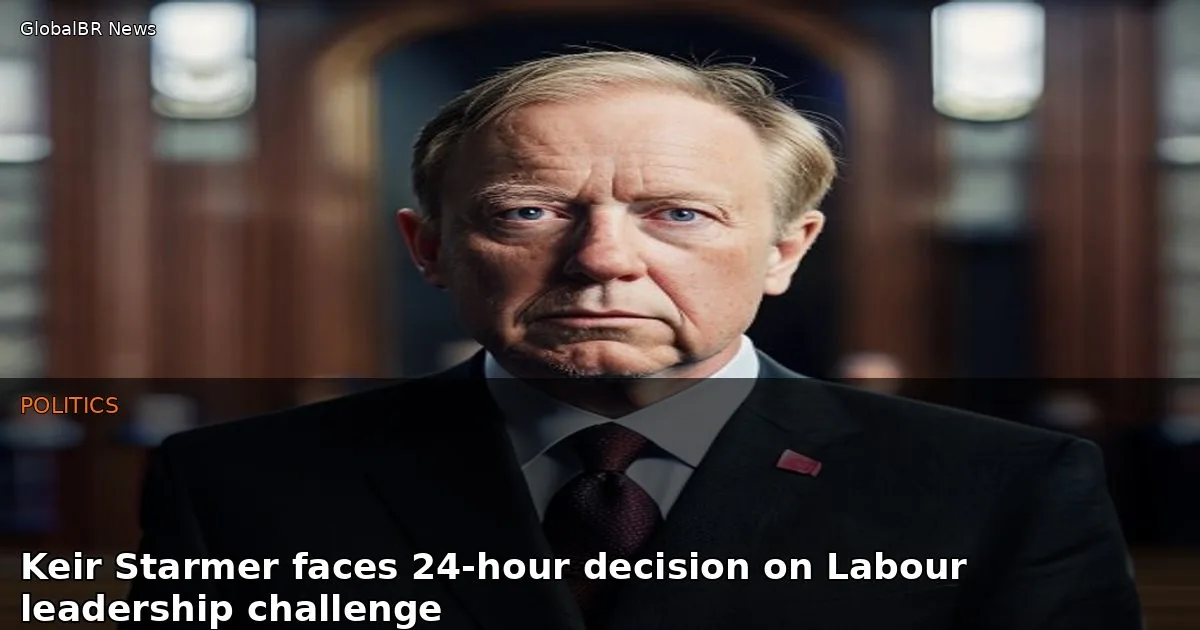
- Prime Minister faces 24-hour deadline to decide on leadership contest.
- Wes Streeting, Yvette Cooper considered as potential replacements.
- Labour MPs push for clarity amid growing party unrest.
📰 Continuing coverage: ‘An hour of abuse’: Jeremy Corbyn on Labour coups, and whether he feels sorry for Starmer
Sir Keir Starmer Labour Party leader and UK Prime Minister, faces a critical 24-hour window to determine his political future. Senior party figures have privately signaled Starmer must act by Tuesday evening to avoid a destabilizing open leadership race. The ultimatum follows weeks of mounting discontent over polling deficits and policy disputes within Labour’s parliamentary ranks.
Sources close to the Shadow Cabinet say pressure intensified after Labour lost ground in recent by-elections, particularly in Wellingborough and Rushden where the party suffered double-digit swings to the opposition. A senior Labour strategist told BBC News that internal polling shows Starmer’s approval rating among party members has fallen below 40% for the first time since he became leader in 2020. This has emboldened a faction of MPs who believe a change could improve Labour’s electoral prospects ahead of the next general election.
Who could replace Starmer?
Among the most frequently named contenders is Wes Streeting, the Health Secretary, who has publicly defended Starmer but privately explored support among backbenchers. Another potential successor is Yvette Cooper, the former Home Secretary, who has not ruled out a bid. Other names circulating include Ed Miliband, the Energy Secretary, and David Lammy, the Foreign Secretary.
Party divisions deepen over future direction
The leadership question has exposed sharp divisions within Labour over its policy platform, particularly on immigration and economic growth. A group of northern Labour MPs argues the party must shift left to reclaim working-class voters. Another faction, led by centrists, insists Labour must maintain its current trajectory to avoid alienating suburban swing voters. These tensions were laid bare during last week’s House of Commons debate on the Spring Budget, where over 30 Labour MPs defied the whip to vote against the government’s measures.
What happens next?
If Starmer chooses to step aside, a leadership contest would likely begin within days. The process would follow Labour’s rules: MPs would whittle down candidates in successive ballots before members vote. The winner would take over as leader and prime minister, potentially reshaping Labour’s agenda and electoral strategy ahead of the next election, due by January 2029. If Starmer stays, he faces a battle to restore party unity and regain momentum in the polls. His allies insist he remains committed to his current course, citing recent legislative successes including the passage of the Economic Activity of Public Bodies (Overseas Matters) Act, which bans public bodies from boycotting Israeli goods.
What You Need to Know
- Source: BBC News
- Published: May 13, 2026 at 18:18 UTC
- Category: Politics
- Topics: #bbc · #politics · #government · #chris-mason · #streeting
Read the Full Story
This is a curated summary. For the complete article, original data, quotes and full analysis:
All reporting rights belong to the respective author(s) at BBC News. GlobalBR News summarizes publicly available content to help readers discover the most relevant global news.
Curated by GlobalBR News · May 13, 2026
Related Articles
🇧🇷 Resumo em Português
O líder trabalhista britânico Keir Starmer se vê pressionado a tomar uma decisão histórica em apenas 24 horas: contestar ou não a liderança do Partido Trabalhista diante de uma onda de insatisfação interna que ganhou força nas últimas semanas. A crise, que expõe divisões profundas entre alas moderadas e progressistas, pode redefinir o futuro da legenda e, consequentemente, da política britânica nos próximos anos.
No Brasil, onde o debate sobre a polarização partidária e a busca por renovação política é recorrente, a situação vivida pelo Labour serve como um espelho das tensões que também assolam formações nacionais. A pressão sobre Starmer reflete não só a fragilidade de lideranças em meio a crises de credibilidade, mas também a necessidade de partidos de se reinventarem para reconquistar eleitores desiludidos. Para os leitores brasileiros, o caso britânico reforça a importância do equilíbrio entre fidelidade ideológica e pragmatismo eleitoral, especialmente em um cenário global de crescente desconfiança nas instituições.
A qualquer momento, Starmer pode anunciar sua saída ou resistir à pressão, mas uma coisa é certa: o Partido Trabalhista não será o mesmo caso a crise se prolongue.
🇪🇸 Resumen en Español
El líder laborista británico, Keir Starmer, se enfrenta a un ultimátum de 24 horas para decidir si acepta el desafío interno que amenaza su liderazgo, en medio de una creciente presión dentro del partido. Fuentes cercanas al círculo de Starmer revelan que los detractores estudian ya los movimientos para desbancarle, lo que añade urgencia a su respuesta.
La crisis en el Labour refleja las tensiones acumuladas tras años de divisiones internas y malos resultados electorales, donde figuras clave exigen un cambio de rumbo bajo el argumento de que Starmer ha perdido el contacto con las bases. Para los votantes hispanohablantes en Reino Unido, este pulso puede tener implicaciones en políticas sociales y migratorias, históricamente divisivas en el seno del partido. Además, la estabilidad de Starmer afecta directamente a la oposición al gobierno conservador de Sunak, en un momento clave para las relaciones post-Brexit y la recuperación económica.
BBC News
Read full article at BBC News →This post is a curated summary. All rights belong to the original author(s) and BBC News.
Was this article helpful?


Discussion