Canada’s PM and top banker met the Artemis II moon crew Friday in Ottawa.
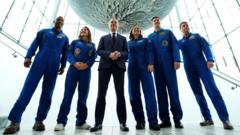
- Canada’s Mark Carney met Artemis II crew in Ottawa with PM Justin Trudeau
- Jeremy Hansen will be first Canadian to orbit the moon on NASA’s 2025 mission
- Carney called it a historic moment for Canada’s space and financial future
Mark Carney, Canada’s former central bank governor and current UN climate envoy, made a rare public appearance in Ottawa Friday to meet the four astronauts who will fly NASA’s Artemis II mission around the moon in 2025. He was joined by Prime Minister Justin Trudeau for a private session with the crew at the Canadian Space Agency’s headquarters. The meeting comes as Canada prepares to become the second country ever to send one of its citizens beyond low Earth orbit—and the first to do so since the Apollo era ended in 1972.
Jeremy Hansen, the Canadian Space Agency astronaut flying on Artemis II, will make history as the first non-American to leave Earth’s orbit. He’ll be strapped into the Orion capsule alongside three NASA astronauts for a ten-day trip that will swing past the moon without landing. It’s the first crewed lunar flyby in over 50 years and a test run for the Artemis III mission that aims to return humans to the moon’s surface in 2026. Hansen, a former fighter pilot from London, Ontario, was selected for the crew in 2023 after two decades with the Canadian Space Agency.
Carney, who now leads the UN’s work on sustainable finance, told reporters the meeting was about more than just space exploration. “This is about showing Canada’s kids that we’re not just watching history—we’re helping build it,” he said. “A country that can send people to the moon can solve climate change too.” The comment reflects Canada’s push to position itself as a leader in both space technology and green energy investment.
Why Canada’s role in Artemis matters
Artemis II isn’t just a stunt. NASA picked Canada to provide the Canadarm3 robotic arm for the future Gateway lunar station, and the country is contributing $2.1 billion Canadian over 24 years for its share of the project. That investment gives Canada four astronaut seats on Artemis missions, starting with Hansen’s spot. The government also sees the program as a way to spark innovation in robotics, AI, and materials science—fields where Canada already has strong companies like MDA Space and Clearpath Robotics.
The meeting in Ottawa wasn’t just ceremonial. Carney and Trudeau used the moment to announce a new federal fund to support Canadian companies developing technologies for lunar missions. That includes tools for mining water ice on the moon and systems to turn that ice into drinkable water or rocket fuel. The funding is part of Canada’s broader push to become a top 10 space economy by 2030, a goal Trudeau’s government has tied to both jobs and national pride.
What’s next for Hansen and the crew
Hansen and his crewmates—NASA’s Reid Wiseman, Victor Glover, and Christina Koch—are in the final stages of training for the 2025 launch. This week’s meeting with Carney and Trudeau was part of a series of public events to build excitement ahead of the mission. The crew has already completed water survival training and long-duration mission simulations, but the real test starts when they strap in next year. If all goes well, their flight will set the stage for Artemis III’s planned lunar landing, where NASA aims to land the first woman and person of color on the moon.
Canada’s investment isn’t just about bragging rights. The country’s space sector already employs 10,000 people and generates $5.5 billion annually. Companies like MDA Space, which built parts of the Canadarm on the International Space Station, are now adapting that tech for lunar use. The Artemis program is giving them a chance to prove their tech in deep space—and maybe win contracts for future Moon bases or Mars missions.
For Hansen, the road to this moment started in 2009 when he was selected as one of Canada’s two new astronauts. He’s spent the last 15 years training, but Friday was different. “This isn’t just about me,” Hansen told reporters after the meeting. “It’s about showing Canada’s next generation that the sky isn’t the limit anymore. We’re going further.” His flight will carry a Canadian flag and a small piece of rock from the Canadian Shield, a nod to the country’s geology and Indigenous heritage.
The bigger picture is clear: Canada is staking its claim in the new space race. Between the moon missions, the push for climate tech, and the billions in contracts on the line, this isn’t just about Hansen’s seat on the rocket. It’s about proving Canada can compete—and lead—in the industries of the future.
What You Need to Know
- Source: BBC News
- Published: May 13, 2026 at 17:02 UTC
- Category: Environment
- Topics: #bbc · #environment · #climate · #politics · #government · #canada
Read the Full Story
This is a curated summary. For the complete article, original data, quotes and full analysis:
All reporting rights belong to the respective author(s) at BBC News. GlobalBR News summarizes publicly available content to help readers discover the most relevant global news.
Curated by GlobalBR News · May 13, 2026
🇧🇷 Resumo em Português
O Canadá recebe pela primeira vez uma tripulação da missão Artemis II da Nasa, um marco que coloca o país no centro da nova corrida espacial, mas também levanta questões sobre o papel do Brasil nesse movimento global. O primeiro-ministro Justin Trudeau se reuniu pessoalmente com os astronautas em Ottawa, enquanto o presidente do Banco do Canadá, Mark Carney, classificou o encontro como histórico, destacando a participação do canadense Jeremy Hansen, único não-americano na missão. Mais do que uma celebração tecnológica, a iniciativa reforça a importância da cooperação internacional no espaço, um tema cada vez mais estratégico para nações como o Brasil, que ainda busca consolidar sua presença no setor aeroespacial.
Para o Brasil, a notícia chega em um momento crucial: o país tenta recuperar o protagonismo perdido desde o programa espacial dos anos 1970 e 1980, com projetos como o foguete VLM-1 e a participação em consórcios internacionais. A participação de Hansen na Artemis II — a primeira missão tripulada à Lua desde 1972 — serve como lembrete de que o Brasil precisa acelerar seus investimentos em ciência e tecnologia espacial para não ficar para trás. Além disso, o Canadá, parceiro tradicional do Brasil em acordos bilaterais, mostra que alianças regionais podem ser decisivas para ingressar em programas de exploração lunar e além.
Enquanto a Artemis II se prepara para decolar em 2025, o Brasil ainda debate como integrar sua indústria aeroespacial a esse novo ciclo, que pode redefinir a geopolítica do espaço nos próximos anos.
BBC News
Read full article at BBC News →This post is a curated summary. All rights belong to the original author(s) and BBC News.
Was this article helpful?

Discussion