ESA orbiter images reveal Mars' ancient flood-carved valleys, showing evidence of the planet's warmer, wetter past.
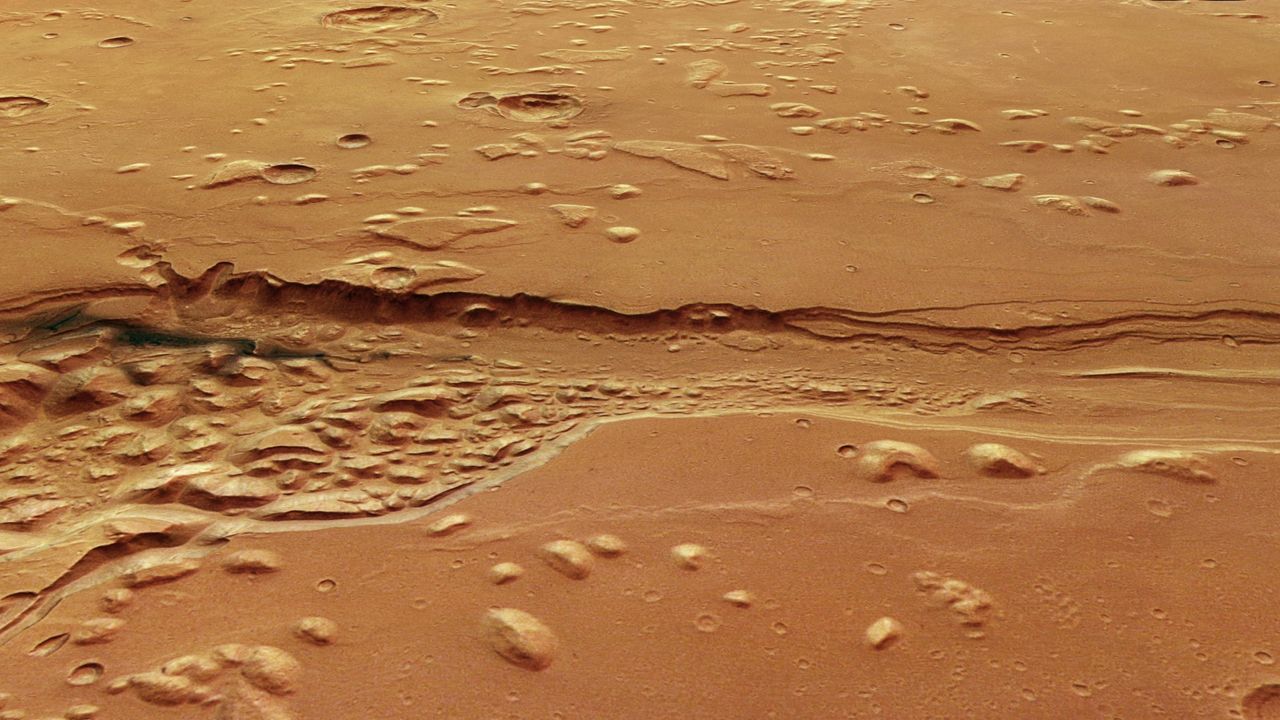
- ESA orbiter captures images of Mars' ancient flood-carved valleys
- Shalbatana Vallis shows evidence of Mars' warmer, wetter past
- Orbiter reveals chaotic terrain and craters formed by ancient floods
The European Space Agency’s Mars Express orbiter has released new high-resolution images of Shalbatana Vallis, a large channel near the Martian equator. The images reveal a patch of chaotic terrain within the valley, marked by craters and ridges believed to have been shaped by ancient floods.
Shalbatana Vallis stretches approximately 650 miles (1,050 kilometers) long, with widths reaching up to 62 miles (100 kilometers) in some areas. The orbiter’s latest observations focus on a small section of this valley, showcasing the dramatic geological features left behind by Mars’ watery past. Scientists believe the region preserves critical evidence that Mars was once significantly warmer and wetter than it is today.
Evidence of Mars’ Ancient Water Systems
The images from Mars Express highlight the chaotic terrain within Shalbatana Vallis, a region where the ground appears jumbled and broken. This type of terrain is often associated with sudden releases of water, which carve out valleys and leave behind distinctive geological formations. Researchers say such features are key to understanding Mars’ hydrological history.
Previous studies have linked Shalbatana Vallis to an ancient lake system within Gusev Crater, where NASA’s Spirit rover once explored. The new images provide further confirmation of the valley’s origins as a flood-carved channel, offering a glimpse into the planet’s dynamic past.
Mars Express Mission and Imaging Technology
Launched in 2003, Mars Express has been orbiting the Red Planet for over two decades, providing valuable data on its geology, atmosphere, and potential for past habitability. The orbiter’s High Resolution Stereo Camera (HRSC) captures detailed images of the Martian surface, allowing scientists to study surface features with unprecedented clarity.
The latest images of Shalbatana Vallis were taken during a recent flyover, with the camera angled to highlight the valley’s geological complexity. The data will be used to refine models of Mars’ ancient climate and hydrology, helping researchers piece together the planet’s evolutionary history.
Implications for Future Mars Exploration
The findings from Mars Express add to a growing body of evidence that Mars once had a climate capable of supporting liquid water on its surface. This has significant implications for future missions, including NASA’s Perseverance rover and the upcoming ESA-Roscosmos ExoMars mission, which aim to search for signs of past microbial life.
Understanding the history of water on Mars is also critical for plans to send humans to the planet. Identifying potential water sources could support future colonization efforts by providing drinking water and the raw material for rocket fuel.
Scientists will continue analyzing the data from Mars Express to uncover more details about Shalbatana Vallis and other regions with similar features. The orbiter’s extended mission ensures that new discoveries will likely emerge in the coming years, further reshaping our understanding of Mars’ past.
What You Need to Know
- Source: Space.com
- Published: May 15, 2026 at 16:00 UTC
- Category: Science
- Topics: #space · #astronomy · #nasa · #war · #conflict · #mars
Read the Full Story
This is a curated summary. For the complete article, original data, quotes and full analysis:
All reporting rights belong to the respective author(s) at Space.com. GlobalBR News summarizes publicly available content to help readers discover the most relevant global news.
Curated by GlobalBR News · May 15, 2026
Related Articles
- 5 Ways to Vet Social Media Health Advice Before Trying It
- PCOS renamed to PMOS after decades of misdiagnosis confusion
🇧🇷 Resumo em Português
A sonda Mars Express, da Agência Espacial Europeia (ESA), acaba de flagrar imagens impressionantes de um dos maiores sinais de que Marte já foi um planeta molhado: o vale Shalbatana Vallis, esculpido por inundações catastróficas há bilhões de anos. As fotos, em alta resolução, mostram um terreno caótico repleto de crateras e leitos secos, relembrando o passado dinâmico do Planeta Vermelho — e levantando a questão: será que a água que moldou essa paisagem poderia, um dia, ter abrigado vida?
O Brasil, que tem investido cada vez mais em ciência espacial — inclusive com parcerias em missões internacionais —, encontra nesta descoberta um novo capítulo para entender não só a história de Marte, mas também os processos geológicos que podem ter ocorrido em outros corpos do Sistema Solar. Para os falantes de português, que acompanham de perto as missões da ESA (como a participação de cientistas brasileiros em projetos europeus), essas imagens reforçam a importância de estudar mundos além da Terra, especialmente quando se busca responder uma das maiores perguntas da humanidade: estamos sozinhos no universo? Além disso, o estudo dessas formações pode ajudar a desvendar segredos sobre a evolução climática de Marte, um tema crucial para futuras missões tripuladas e até mesmo para a colonização do planeta.
Agora, os pesquisadores devem analisar esses dados com mais profundidade, enquanto a Mars Express continua a orbitar o Planeta Vermelho em busca de novas evidências — e, quem sabe, sinais de que a água, e quem a habitou, ainda escondem segredos por lá.
🇪🇸 Resumen en Español
La sonda Mars Express de la Agencia Espacial Europea (ESA) ha captado imágenes espectaculares de los vestigios de gigantescas inundaciones que hace miles de millones de años moldearon el paisaje de Marte, concretamente en la región de Shalbatana Vallis.
Estas fotografías de alta resolución no solo confirman que el planeta rojo albergó grandes cantidades de agua líquida en el pasado, sino que también ofrecen pistas sobre cómo estos fenómenos pudieron alterar su superficie. Para los hispanohablantes, especialmente para los científicos y estudiantes de astronomía en España y Latinoamérica, estas imágenes refuerzan el interés en la exploración marciana y abren nuevas preguntas sobre la posibilidad de vida microbiana antigua o incluso sobre futuras misiones tripuladas.
Space.com
Read full article at Space.com →This post is a curated summary. All rights belong to the original author(s) and Space.com.
Was this article helpful?


Discussion