Trump and Xi ended two days of talks with no major deals but agreed to deepen trade and security cooperation.
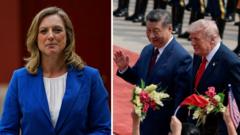
- Trump and Xi held two days of closed-door meetings in Beijing
- No new trade deals announced but both sides agreed to expand cooperation
- US president praised Xi and China’s hospitality during state visit
President Donald Trump concluded his two-day state visit to Beijing on Thursday following intensive talks with Chinese leader Xi Jinping https://en.wikipedia.org/wiki/Xi_Jinping. The meetings, described by both sides as constructive, covered trade, security, and regional issues, though no major agreements were announced.
Trade and economic ties take center stage
Trade dominated the agenda as Trump pressed China to reduce its $375 billion annual trade surplus with the United States. While no new trade deals were finalized, both leaders emphasized the importance of expanding economic cooperation. Trump praised China’s market potential and urged American companies to invest more aggressively in the country. State media reported that Chinese officials agreed to ease restrictions on some US financial services and agricultural products, though details remained unclear.
The two leaders also addressed longstanding concerns over intellectual property theft and market access barriers for foreign firms. Trump highlighted progress in preliminary discussions but offered no specifics on enforcement mechanisms. Analysts noted that symbolic gestures, such as the signing of non-binding memoranda, could signal a willingness to reopen stalled negotiations.
Security and North Korea dominate strategic talks
Beyond economics, the summit addressed regional security, particularly North Korea’s nuclear program. Trump and Xi reaffirmed their commitment to denuclearization, though differing approaches emerged. China reiterated its support for UN sanctions while calling for dialogue, a stance aligned with Washington’s stated goal but diverging on tactics. The leaders also discussed maritime disputes in the South China Sea https://en.wikipedia.org/wiki/South_China_Sea_disputes and cybersecurity, areas where tensions have flared in recent years.
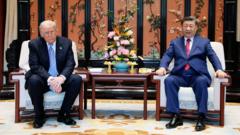
Chinese state television showed footage of Trump and Xi strolling through the Forbidden City https://en.wikipedia.org/wiki/Forbidden_City, underscoring the diplomatic pageantry of the visit. Trump called the historic site “magnificent” and thanked Xi for the warm reception, a contrast to the frosty public exchanges during previous high-level meetings.
Business delegations sign non-binding agreements
During the visit, US and Chinese business leaders announced a series of non-binding agreements worth tens of billions of dollars. Boeing https://en.wikipedia.org/wiki/Boeing said it would sell 300 aircraft to Chinese carriers, while energy firms including ExxonMobil https://en.wikipedia.org/wiki/ExxonMobil discussed long-term supply deals. These announcements, while not legally enforceable, signal private sector interest in stabilizing relations.
Critics argue the lack of enforceable commitments leaves room for backsliding. “These are goodwill gestures, not structural changes,” said Derek Scissors, a China specialist at the American Enterprise Institute. “The real test will be whether China follows through on market-opening measures.”
Looking ahead, both sides indicated they would continue negotiations on trade and security. Trump is scheduled to visit Vietnam and the Philippines next, where he will attend regional summits. Analysts expect the US-China relationship to remain a focal point, with trade and North Korea likely dominating future discussions.
What You Need to Know
- Source: BBC News
- Published: May 15, 2026 at 13:25 UTC
- Category: World
- Topics: #bbc · #world-news · #international · #politics · #government · #watch
Read the Full Story
This is a curated summary. For the complete article, original data, quotes and full analysis:
All reporting rights belong to the respective author(s) at BBC News. GlobalBR News summarizes publicly available content to help readers discover the most relevant global news.
Curated by GlobalBR News · May 15, 2026
Related Articles
- US proposes 40% cut in Colorado River water for 3 states amid drought
- Trump urges Taiwan to avoid independence amid rising China tensions
- Xi gives Trump private tour of secret garden in Beijing
🇧🇷 Resumo em Português
Donald Trump encerrou sua primeira visita oficial à China como presidente dos Estados Unidos com um saldo de promessas bilionárias e tensões estratégicas ainda não resolvidas, reacendendo o debate sobre os rumos da relação entre as duas maiores economias do mundo. Em dois dias de encontros com Xi Jinping, Trump selou acordos que, se concretizados, podem injetar centenas de bilhões de dólares em negócios entre empresas americanas e chinesas, mas deixou escapar críticas veladas ao déficit comercial que tanto incomoda Washington.
O contexto não poderia ser mais delicado: enquanto Trump busca reduzir o rombo comercial com a China — que fechou 2022 em US$ 382 bilhões em favor de Pequim — e pressiona por mudanças na política industrial chinesa, Xi Jinping demonstrou firmeza ao evitar concessões significativas em temas sensíveis, como propriedade intelectual e subsídios estatais. Para o Brasil, o desdobramento dessas negociações é crucial, já que o país depende diretamente do mercado chinês para suas exportações, especialmente de commodities como soja e minério de ferro. Além disso, a guerra comercial entre EUA e China já afeta indiretamente a economia brasileira, com reflexos em preços, câmbio e fluxos de investimento.
A visita revelou que, apesar das aparências de cordialidade, as divergências entre Washington e Pequim seguem profundas, e os próximos meses serão decisivos para saber se os acordos assinados se transformarão em ações concretas ou permanecerão como retórica diplomática.
🇪🇸 Resumen en Español
La visita relámpago de Donald Trump a Pekín ha dejado al descubierto las complejas tensiones entre Washington y Pekín, donde el intercambio de gestos diplomáticos y acuerdos económicos no logró disipar las profundas diferencias estratégicas.
A pesar de los elogios mutuos y la firma de contratos millonarios, especialmente en el sector energético y financiero, la cumbre evidenció que el corazón del desacuerdo sigue siendo el mismo: la rivalidad por la hegemonía tecnológica y militar. Para los hispanohablantes, este pulso entre las dos mayores economías del mundo tiene implicaciones globales, desde el alza en los precios de productos básicos hasta la incertidumbre en los mercados emergentes, donde países como México o España podrían verse arrastrados por una guerra comercial prolongada. La pregunta que queda en el aire es si este acercamiento superficial se traducirá en una cooperación real o, por el contrario, en una escalada de medidas proteccionistas que sacudirían el orden económico internacional.
BBC News
Read full article at BBC News →This post is a curated summary. All rights belong to the original author(s) and BBC News.
Was this article helpful?

Discussion