ViaSat-3 F2 satellite deploys giant reflector in rare space photo with Earth photobombing the shot.
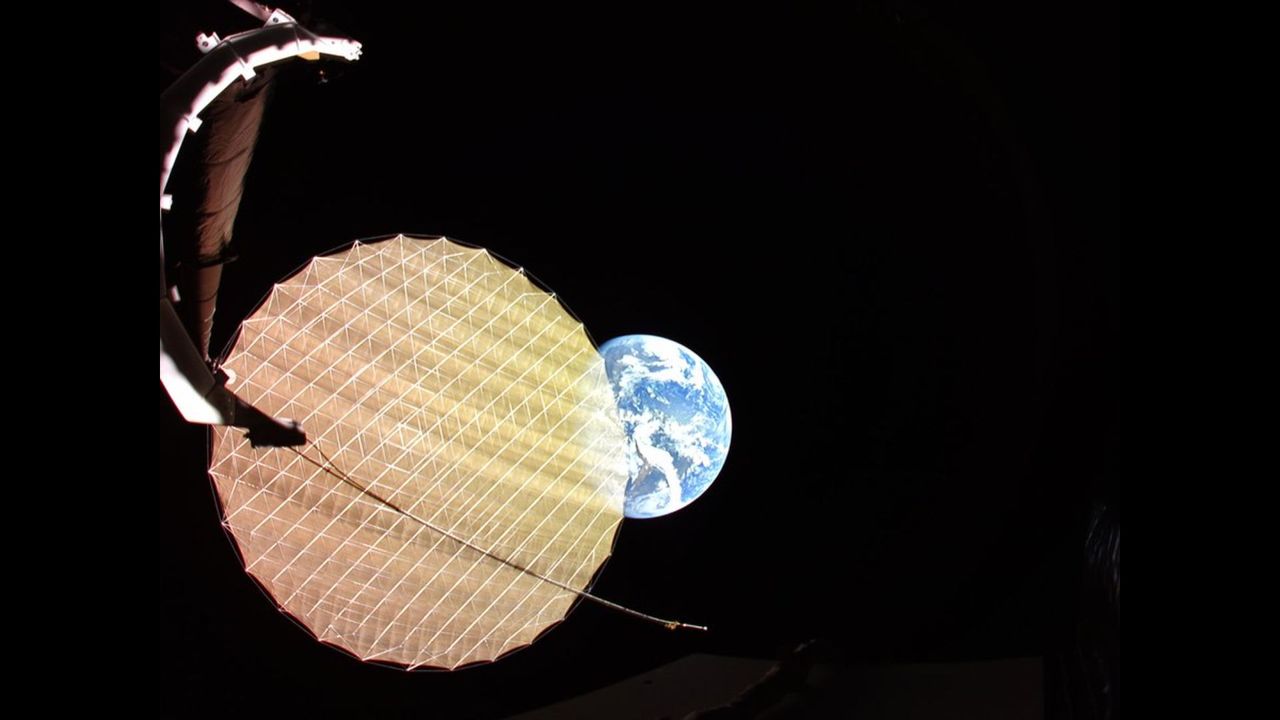
- Satellite deploys giant reflector in rare space photo
- Earth photobombs reflector deployment against black space
- ViaSat-3 F2 captures striking image of honeycomb-pattern reflector
A ViaSat-3 F2 satellite from ViaSat captured a striking image Wednesday as its massive reflector fully deployed with Earth photobombing the shot. The semi-transparent yellow honeycomb pattern partially overlapped the left third of the planet, creating a rare visual contrast against the black backdrop of space. The deployment marks a critical milestone for the high-capacity communications satellite, designed to expand global broadband coverage. Engineers confirmed the reflector extended as planned, a process monitored in real time from ViaSat mission control in Tempe, Arizona. The image, shared Thursday by Space.com, offers a unique perspective on the satellite’s engineering and the vastness of space.
ViaSat-3 F2 marks next-gen satellite technology
The ViaSat-3 constellation represents a new generation of high-throughput satellites, capable of delivering terabit-level data speeds. The F2 satellite, launched April 7, 2026, is positioned at 115° West longitude to serve the Americas. Its reflector, spanning roughly 14 meters, is one of the largest ever deployed in space. The honeycomb design reduces weight while maintaining structural integrity, a key innovation for reducing launch costs. Competitors like SpaceX and SES are also developing next-gen reflectors, but ViaSat’s deployment sequence is among the most closely watched. The F2 joins its sibling, the ViaSat-3 F1, which began service in 2023 over the Atlantic.
Earth photobombs space milestone
The photobombing effect occurred as the satellite’s reflector extended outward, aligning with Earth’s curvature during deployment. Engineers described the moment as both an engineering triumph and a visual spectacle. The semi-transparent nature of the reflector allowed sunlight to pass through, casting a faint shadow on the planet’s surface below. Spacecraft imagery like this is rare, as satellites typically prioritize mission data over photography. The image was captured by an onboard monitoring camera, a standard feature for deployment verification. Such photos can also serve public relations and educational purposes, helping demystify satellite technology for global audiences. The F2’s reflector is expected to remain in its deployed state for the satellite’s 15-year lifespan.
Next steps for ViaSat-3 F2
Following reflector deployment, the ViaSat-3 F2 will undergo a series of in-orbit tests to validate its communications payload. These tests will measure signal strength, latency, and coverage across the Americas. Once operational, the satellite will provide high-speed internet to underserved regions, including rural and maritime areas. ViaSat plans to launch the third satellite in the constellation, the ViaSat-3 F3, later in 2026. The F3 will target the Asia-Pacific region, further expanding the company’s global footprint. The reflector deployment image may soon appear in textbooks and outreach materials to highlight advancements in satellite engineering. The F2’s success sets the stage for broader adoption of large reflector technology in future missions.
What You Need to Know
- Source: Space.com
- Published: May 14, 2026 at 14:00 UTC
- Category: Science
- Topics: #space · #astronomy · #nasa · #science · #earth · #viasat-3-f2-reflector-deployment
Read the Full Story
This is a curated summary. For the complete article, original data, quotes and full analysis:
All reporting rights belong to the respective author(s) at Space.com. GlobalBR News summarizes publicly available content to help readers discover the most relevant global news.
Curated by GlobalBR News · May 14, 2026
Related Articles
- 5 Ways to Vet Social Media Health Advice Before Trying It
- Your Body Clock May Enhance The Benefits of Exercise, Study Finds
- Study finds yawns contagious before birth, even more than thought
🇧🇷 Resumo em Português
Um satélite da ViaSat-3 F2 registrou um momento histórico no espaço: enquanto desdobrava um imenso refletor semicircular, a Terra surgiu no fundo da imagem, como se fizesse um “photobomb” em pleno cosmos. A cena, que lembra um olho gigante flutuando no vazio, não só impressiona pela beleza incomum, como também revela o avanço tecnológico por trás da comunicação via satélite de alta performance.
Esse feito, embora ocorrido a centenas de quilômetros da superfície terrestre, tem impacto direto no Brasil e em países lusófonos que dependem de conectividade rápida e estável. O refletor, com sua estrutura de favo de mel semi-transparente, é parte essencial do satélite, projetado para ampliar o sinal de internet em regiões remotas ou com infraestrutura limitada — um problema recorrente em áreas do Norte e Nordeste brasileiro. A tecnologia, desenvolvida por empresas como a Boeing e a ViaSat, promete reduzir a chamada “divisão digital” em territórios onde a fibra óptica ainda não chega, possibilitando acesso à internet de alta velocidade para milhões de pessoas.
O lançamento bem-sucedido do ViaSat-3 F2 abre caminho para uma nova geração de satélites de comunicação, que poderão transformar a realidade de milhões de brasileiros e falantes de português em todo o mundo.
🇪🇸 Resumen en Español
La imagen captada por el satélite ViaSat-3 F2 ha sorprendido al mundo al mostrar cómo la Tierra se coló en el encuadre justo cuando su enorme reflector metálico se desplegaba en el espacio, creando un efecto visual único. La fotografía, que recuerda a un fotobomba cósmica, revela la delicadeza de una estructura semitransparente en forma de panal, diseñada para transmitir señales de internet, mientras nuestro planeta asoma en segundo plano como un gigantesco telón azul.
Esta instantánea no solo destaca por su rareza estética, sino por lo que representa: el avance tecnológico en comunicaciones satelitales y la precisión de las maniobras espaciales. Para los hispanohablantes, el hito adquiere relevancia al subrayar cómo empresas como Viasat —con fuerte presencia en Latinoamérica— están expandiendo la conectividad en regiones remotas, un tema clave en la era digital. Además, la imagen sirve como recordatorio visual del papel cada vez más protagonista de la tecnología satelital en la vida cotidiana, desde el acceso a internet hasta la observación del clima.
Space.com
Read full article at Space.com →This post is a curated summary. All rights belong to the original author(s) and Space.com.
Was this article helpful?



Discussion