Trump and Xi end talks with few trade deals but positive rhetoric after two-day Beijing summit.
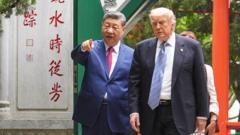
- Trump and Xi held two-day talks in Beijing with no major trade breakthroughs
- Both leaders called meetings 'very successful' despite no confirmed deals
- Choreographed ceremonies overshadowed substantive agreements
The highly anticipated meeting between US President Donald Trump and China’s President Xi Jinping concluded on Thursday with handshakes, smiles and scripted ceremonies, but no major trade agreements were announced. The talks, which spanned two days in Beijing, were framed by both sides as productive, yet concrete outcomes were scarce beyond general commitments to continued negotiations.
Ceremonies overshadowed by lack of new deals
Photos of Trump and Xi shaking hands in front of China’s Great Hall of the People dominated coverage, but behind the scenes, negotiators failed to finalize any new trade pacts. Chinese state media emphasized the “friendly atmosphere” of the meetings, while the White House described the discussions as “constructive.” However, officials on both sides sidestepped questions about specific concessions or timelines for resolving the ongoing trade dispute that has rattled global markets.
The absence of new deals follows months of escalating tariffs and retaliatory measures between the world’s two largest economies. Earlier this year, the US imposed tariffs on $200 billion worth of Chinese goods, prompting Beijing to retaliate with duties on $60 billion of American products. Analysts say the lack of progress risks prolonging uncertainty for businesses on both sides.
Rhetoric contrasts with limited outcomes
Despite the upbeat tone, no timeline was set for the next round of negotiations. Trump, who has repeatedly criticized China’s trade practices, told reporters the talks were “big and very successful,” while Xi called for “win-win cooperation” in future dealings. Yet neither leader provided details on progress toward resolving core issues such as intellectual property theft, forced technology transfers or agricultural market access.
The summit took place against a backdrop of rising geopolitical tensions, including disputes over Huawei’s global expansion, cybersecurity concerns and China’s territorial claims in the South China Sea. While trade was the stated focus, these broader issues loomed large in the background, complicating efforts to reach a comprehensive deal.
Markets react with cautious optimism
Global stock markets showed little reaction to the summit’s conclusion, with investors focusing instead on the lack of tangible progress. The S&P 500 and Dow Jones Industrial Average closed slightly lower on Thursday, reflecting skepticism about the talks’ ability to resolve longstanding disputes. Analysts at Goldman Sachs noted that without concrete steps, market volatility tied to US-China trade tensions could persist.
The outcome leaves businesses in both countries in a state of limbo. American farmers, who have been hit hard by China’s retaliatory tariffs on soybeans and pork, had hoped for relief. Meanwhile, Chinese exporters facing US tariffs on electronics and machinery remain uncertain about future demand. The delay in resolving these issues could further strain supply chains already disrupted by the trade war.
Looking ahead, both sides signaled willingness to keep talking, with Trump suggesting additional meetings could take place early next year. However, the lack of a clear roadmap raises questions about whether the rhetoric of success will translate into meaningful action. Until then, the stalemate in US-China trade relations appears set to continue, with global economic implications hanging in the balance.
What You Need to Know
- Source: BBC News
- Published: May 15, 2026 at 21:50 UTC
- Category: Business
- Topics: #bbc · #business · #economy · #trump · #there · #trump-xi-talks-beijing
Read the Full Story
This is a curated summary. For the complete article, original data, quotes and full analysis:
All reporting rights belong to the respective author(s) at BBC News. GlobalBR News summarizes publicly available content to help readers discover the most relevant global news.
Curated by GlobalBR News · May 15, 2026
Related Articles
🇧🇷 Resumo em Português
Em um encontro marcado por pompa e expectativa, os presidentes dos Estados Unidos e da China encerraram dois dias de negociações com promessas de aproximação, mas sem grandes avanços concretos no comércio bilateral. A cúpula entre Donald Trump e Xi Jinping, descrita como “muito bem-sucedida” por Washington, manteve a retórica otimista, mas deixou no ar dúvidas sobre quando — ou se — os dois gigantes econômicos vão resolver suas tensas disputas tarifárias.
O encontro ocorre em um momento crítico para a economia global, com o Brasil atento não só aos desdobramentos comerciais entre as duas maiores potências, mas também aos reflexos indiretos no mercado brasileiro. Com a China como principal parceiro comercial do país, qualquer sinal de trégua ou escalada na guerra comercial pode impactar diretamente as exportações brasileiras de commodities, como soja e minério de ferro. Além disso, a volatilidade nos mercados financeiros, impulsionada por incertezas geopolíticas, afeta diretamente o câmbio e os investimentos no Brasil, que busca recuperar sua economia após anos de instabilidade. Para o leitor brasileiro, o que importa não é apenas o que foi dito em Washington, mas como esses acordos — ou a falta deles — reverberarão nas prateleiras dos supermercados e nos portos do país.
O próximo passo deve vir nas próximas semanas, quando os dois países devem detalhar medidas pontuais para aliviar as tensões, embora o cenário de uma trégua duradoura ainda pareça distante.
🇪🇸 Resumen en Español
El presidente de Estados Unidos, Donald Trump, y su homólogo chino, Xi Jinping, cerraron dos días de intensas negociaciones con un discurso triunfalista, aunque sin acuerdos concretos que alivien la tensión comercial entre ambas potencias.
Los expertos ven en estas conversaciones, más que avances reales, un gesto de distensión para calmar los mercados, que castigan la incertidumbre generada por la guerra arancelaria. Para los hispanohablantes, especialmente en Latinoamérica, el resultado refuerza la idea de que el proteccionismo global sigue dominando la agenda, con riesgos para economías dependientes de exportaciones y cadenas de suministro. La falta de compromisos claros deja en el aire la posibilidad de nuevos roces, mientras el mundo observa si el diálogo se traduce en hechos.
BBC News
Read full article at BBC News →This post is a curated summary. All rights belong to the original author(s) and BBC News.
Was this article helpful?

Discussion