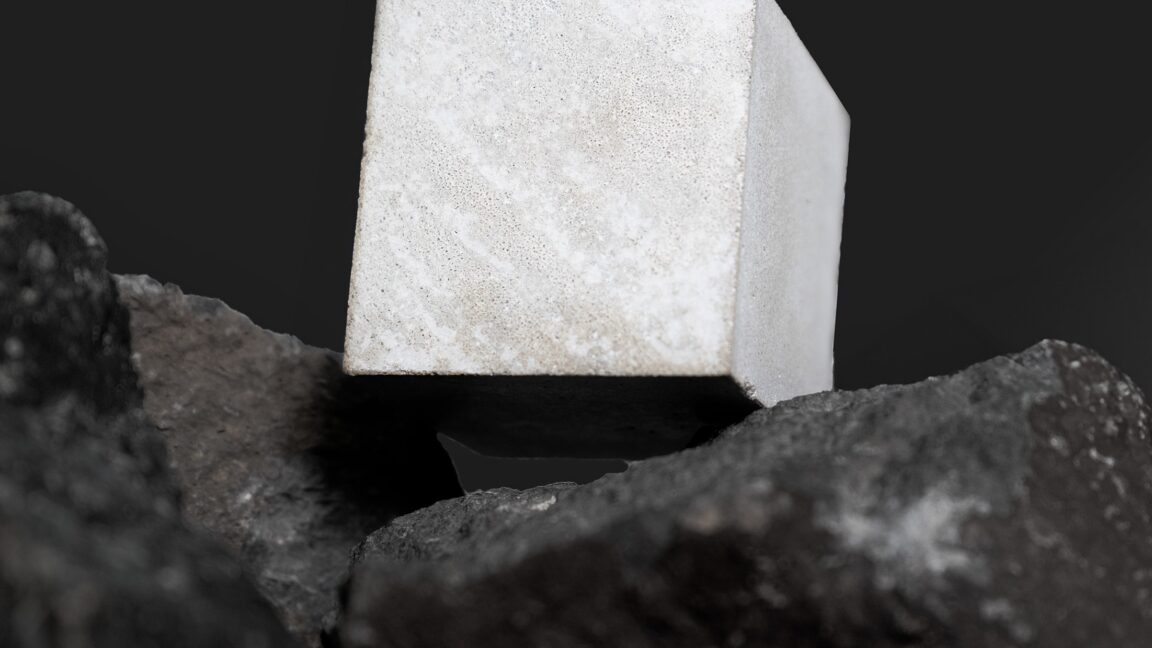
Swap limestone for basalt in cement and cut the industry’s CO2 emissions by 8% of global totals.
- Cement production causes 8% of global CO2 emissions today
- Most of those emissions come from limestone, not fuel burning
- Basalt-based cement eliminates the CO2 released during heating
The cement in your sidewalk, your office building, and the bridge you drove over this morning has a dirty secret. Making it releases more CO2 than the entire aviation industry. That’s not from the trucks or the kilns—it’s from the rock itself. Limestone, the key ingredient in Portland cement, turns into lime and CO2 gas when heated. The chemistry is simple: CaCO3 → CaO + CO2. That CO2 isn’t just a byproduct. It’s baked into the process, accounting for slightly more emissions than burning coal or gas to run the kilns. Right now, there’s no way around it. Or is there? A new study in Communications Sustainability proposes a radical tweak: stop using limestone altogether. Replace it with basalt, a common volcanic rock that doesn’t release CO2 when heated. The team, led by researchers at University of Cambridge, ran lab tests and found basalt-based cement meets standard strength requirements while cutting direct emissions to zero. The catch? It’s not ready for mass production yet. Basalt is abundant—it covers most of the ocean floor and large chunks of continents like India and the Pacific Northwest—but turning it into cement requires a different recipe and new kiln designs. The researchers estimate the technology could cut global cement emissions in half if scaled up. That’s a huge deal because cement production is expected to grow as cities in Africa and Asia expand. The industry’s been chasing solutions for years: carbon capture, cleaner kilns, clinker substitutes. But none tackle the core problem—the CO2 that comes straight out of the rock. Basalt skips that step entirely. It’s not a perfect fix. Mining and transporting basalt still has an environmental cost, and the cement sets more slowly than Portland, which could slow down construction schedules. But the math is compelling. A typical cement plant emits about 800,000 tons of CO2 a year from limestone. Switching to basalt could erase that footprint without changing the final product. The team is now partnering with a German cement maker to test the process at an industrial scale. If it works, the change won’t happen overnight. Building codes, supply chains, and decades of industry standards are all built around Portland cement. But the pressure to act is rising. The International Energy Agency says the cement sector needs to cut emissions 24% by 2030 to meet climate goals. Basalt could be the shortcut the industry hasn’t been willing to take—until now.
What You Need to Know
- Source: Ars Technica
- Published: May 15, 2026 at 17:06 UTC
- Category: Technology
- Topics: #arstechnica · #tech · #science · #making · #cement · #communications-sustainability
Read the Full Story
This is a curated summary. For the complete article, original data, quotes and full analysis:
All reporting rights belong to the respective author(s) at Ars Technica. GlobalBR News summarizes publicly available content to help readers discover the most relevant global news.
Curated by GlobalBR News · May 15, 2026
Related Articles
🇧🇷 Resumo em Português
O Brasil, que já é um dos maiores produtores e consumidores de cimento do mundo, pode estar diante de uma revolução silenciosa na construção civil. Pesquisadores internacionais apresentaram uma fórmula inovadora que promete reduzir drasticamente as emissões de CO₂ do setor, responsável por 8% das emissões globais do gás. A solução? Substituir o tradicional calcário (ou limestone) por basalto, uma rocha vulcânica abundante em várias regiões do país, inclusive no sul e sudeste.
A técnica, ainda em fase de testes, promete cortar até 80% das emissões associadas à produção de cimento, um material indispensável para a infraestrutura brasileira. Atualmente, o processo de fabricação do cimento libera grandes quantidades de CO₂, tanto pela queima do combustível quanto pela decomposição química do calcário. Com o basalto, a reação química produziria menos gases poluentes e ainda poderia reduzir o consumo de energia. No Brasil, onde obras de grande porte, como barragens e rodovias, dependem massivamente do cimento, a adoção dessa nova tecnologia poderia alinhar o setor às metas de sustentabilidade, como as estabelecidas pelo Acordo de Paris.
Se comprovada sua eficácia em larga escala, a inovação não só transformaria a indústria nacional como também poderia posicionar o Brasil como líder global em cimento verde, abrindo caminho para exportações de uma tecnologia limpa.
🇪🇸 Resumen en Español
La industria cementera, responsable de un 8% de las emisiones globales de CO₂, da un paso revolucionario al sustituir la piedra caliza por basalto en sus fórmulas, reduciendo drásticamente su huella climática. Este cambio no solo promete transformar un sector históricamente contaminante, sino que podría redefinir los estándares de sostenibilidad en la construcción a nivel mundial.
El basalto, una roca volcánica abundante y de bajo costo, se postula como alternativa viable gracias a su composición química, que evita la liberación de CO₂ durante su procesamiento, a diferencia del tradicional uso de caliza. Según los investigadores, esta innovación no solo mantendría la calidad del cemento, sino que incluso podría mejorar su resistencia y durabilidad. Para los hispanohablantes, especialmente en regiones con alta actividad constructora como Latinoamérica o España, esta tecnología abre una puerta a reducir el impacto ambiental sin sacrificar el desarrollo urbano, alineándose con los compromisos climáticos internacionales y ofreciendo un modelo replicable en economías emergentes.
Ars Technica
Read full article at Ars Technica →This post is a curated summary. All rights belong to the original author(s) and Ars Technica.
Was this article helpful?


Discussion