Neutron star collisions may fling superheavy particles that become ultra-high-energy cosmic rays striking Earth.
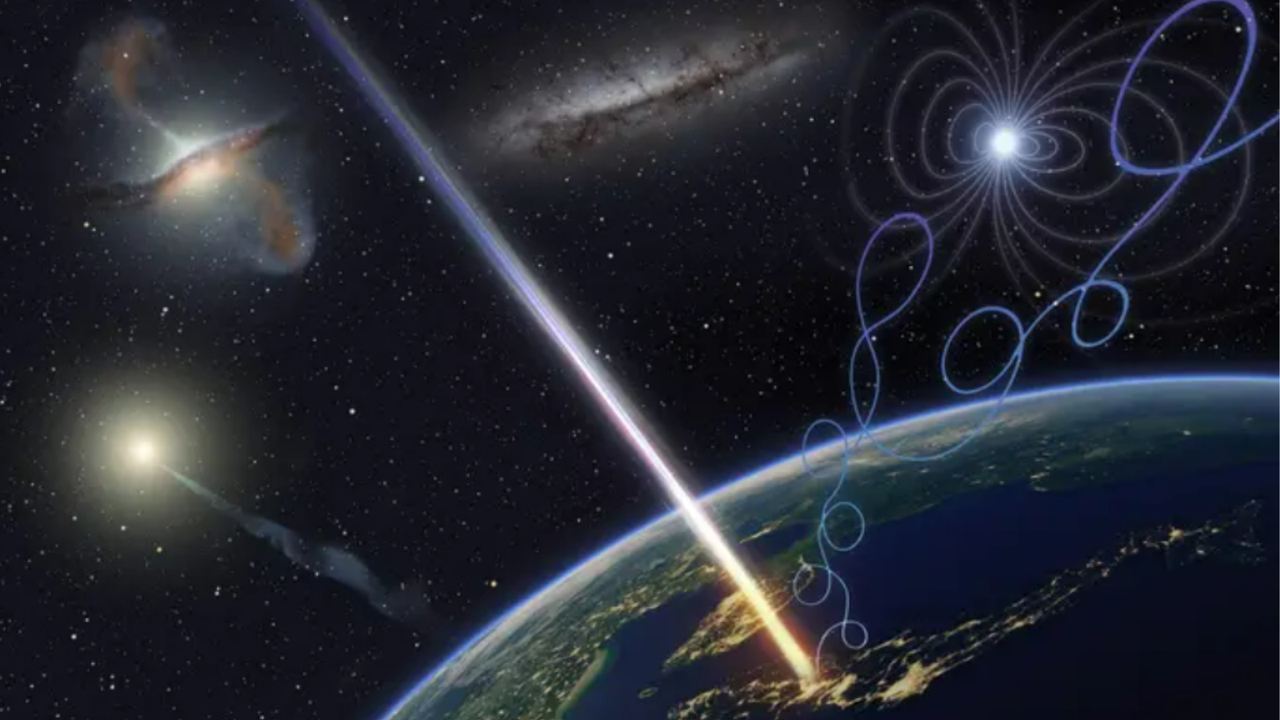
- Neutron star mergers may produce cosmic rays 10 million times stronger than LHC particles
- Superheavy particles from collisions could solve decades-old cosmic ray mystery
- Cosmic rays strike Earth daily but origin has remained unknown since 1960s
Scientists have long puzzled over the origin of cosmic rays—high-energy particles that constantly bombard Earth. A new study published in Physical Review Letters suggests that some of the most powerful cosmic rays may originate from cataclysmic events: the merger of two neutron stars. These collisions release energy so intense that they could fling superheavy particles into space at speeds approaching the speed of light.
The findings address a long-standing mystery in astrophysics. Since the 1960s, researchers have detected cosmic rays with energies exceeding 10^20 electron volts—far beyond what can be generated by even the most powerful particle accelerators on Earth. The Large Hadron Collider, for example, accelerates particles to only about 10^13 electron volts. Yet despite decades of investigation, no definitive source has been confirmed for these ultra-high-energy cosmic rays.
Neutron star mergers as cosmic particle accelerators
The study’s authors propose that when two neutron stars collide, their merger creates conditions extreme enough to produce superheavy particles. These particles could then decay into the cosmic rays detected on Earth. Neutron star mergers are among the most violent events in the universe, releasing more energy in seconds than the sun will produce in its entire lifetime. The gravitational waves from such events were first detected in 2017 by the LIGO and Virgo observatories, confirming Einstein’s century-old predictions.
Superheavy particles: a possible solution
The idea of superheavy particles is not new, but their existence has never been confirmed. These particles, if they exist, would have masses far greater than any known particle, potentially explaining how such high energies are achieved. The decay of these particles could produce the cosmic rays observed on Earth. While no direct evidence of superheavy particles has been found, their theoretical framework provides a plausible explanation for the origin of ultra-high-energy cosmic rays.
Observational challenges and future research
Detecting these cosmic rays is no easy feat. They interact with the atmosphere and rarely reach ground-based detectors. Most are observed indirectly through extensive air showers—cascades of secondary particles created when cosmic rays collide with atmospheric molecules. However, observatories like the Pierre Auger Observatory in Argentina and the Telescope Array in Utah have recorded thousands of these events, providing data that scientists use to trace their origins.
Future research will focus on pinpointing the source of these cosmic rays with greater precision. Upcoming gravitational wave detectors, such as the next-generation LIGO and Virgo upgrades, could help correlate neutron star mergers with cosmic ray detections. Additionally, advances in particle physics may uncover evidence of superheavy particles in high-energy collision experiments.
The implications of this research extend beyond solving a 60-year-old puzzle. Understanding the origin of cosmic rays could provide insights into the most extreme environments in the universe and the fundamental laws governing them. It may also shed light on the nature of dark matter, which is thought to make up most of the universe’s mass but has never been directly observed.
For now, the mystery persists, but the pieces are beginning to fall into place. Neutron star mergers offer a compelling explanation for some of the universe’s most energetic events, and the search for superheavy particles could unlock answers to questions that have lingered for decades.
What You Need to Know
- Source: Space.com
- Published: May 13, 2026 at 19:00 UTC
- Category: Science
- Topics: #space · #astronomy · #nasa · #earth · #high · #cosmic-rays-origin
Read the Full Story
This is a curated summary. For the complete article, original data, quotes and full analysis:
All reporting rights belong to the respective author(s) at Space.com. GlobalBR News summarizes publicly available content to help readers discover the most relevant global news.
Curated by GlobalBR News · May 13, 2026
Related Articles
- 5 Ways to Vet Social Media Health Advice Before Trying It
- PCOS renamed to PMOS after decades of misdiagnosis confusion
🇧🇷 Resumo em Português
Pela primeira vez, cientistas desvendam um dos maiores mistérios do cosmos: o que dispara poderosas partículas chamadas “raios cósmicos” em direção à Terra. Recentemente, pesquisadores identificaram que colisões entre estrelas de nêutrons — eventos cataclísmicos que liberam energia equivalente a bilhões de sóis — são responsáveis por acelerar essas partículas a velocidades próximas à da luz, transformando-as em verdadeiros projéteis espaciais que bombardeiam nosso planeta.
A descoberta, publicada em renomadas revistas científicas, tem implicações profundas para o Brasil e a comunidade científica lusófona. Não só amplia nosso entendimento sobre a origem dos raios cósmicos ultraenergéticos — que até então desafiavam explicações —, como também reforça a importância de investimentos em pesquisa astronômica no hemisfério Sul, onde observatórios como o Observatório Pierre Auger, na Argentina, desempenham papel crucial. Além disso, entender esses fenômenos pode ajudar a prever riscos para satélites e tecnologias terrestres, cada vez mais vulneráveis à radiação espacial.
Agora, os cientistas preparam novas observações com telescópios de última geração, como o observatório Cherenkov Telescope Array, para rastrear esses eventos em tempo real e confirmar se outras fontes, como buracos negros supermassivos, também contribuem para o fenômeno.
🇪🇸 Resumen en Español
Los científicos han resuelto uno de los enigmas más fascinantes del cosmos: el origen de los rayos cósmicos ultraenergéticos que bombardean la Tierra. Tras décadas de investigación, un estudio reciente vincula estas partículas misteriosas con las violentas colisiones de estrellas de neutrones, eventos que liberan una energía comparable a la de miles de supernovas.
El hallazgo, publicado en Science, no solo ilumina un fenómeno que ha intrigado a físicos desde su descubrimiento en 1912, sino que también abre nuevas líneas de estudio sobre la formación de elementos pesados en el universo. Para los hispanohablantes, especialmente en países con comunidades científicas activas como España o México, esta investigación subraya la importancia de la colaboración internacional en astronomía, así como el papel clave de instrumentos como el Observatorio Pierre Auger en Argentina, uno de los mayores detectores de rayos cósmicos del mundo. Además, plantea preguntas sobre cómo estos fenómenos podrían afectar, en escalas de tiempo geológicas, a la evolución de la vida en nuestro planeta.
Space.com
Read full article at Space.com →This post is a curated summary. All rights belong to the original author(s) and Space.com.
Was this article helpful?
Discussion