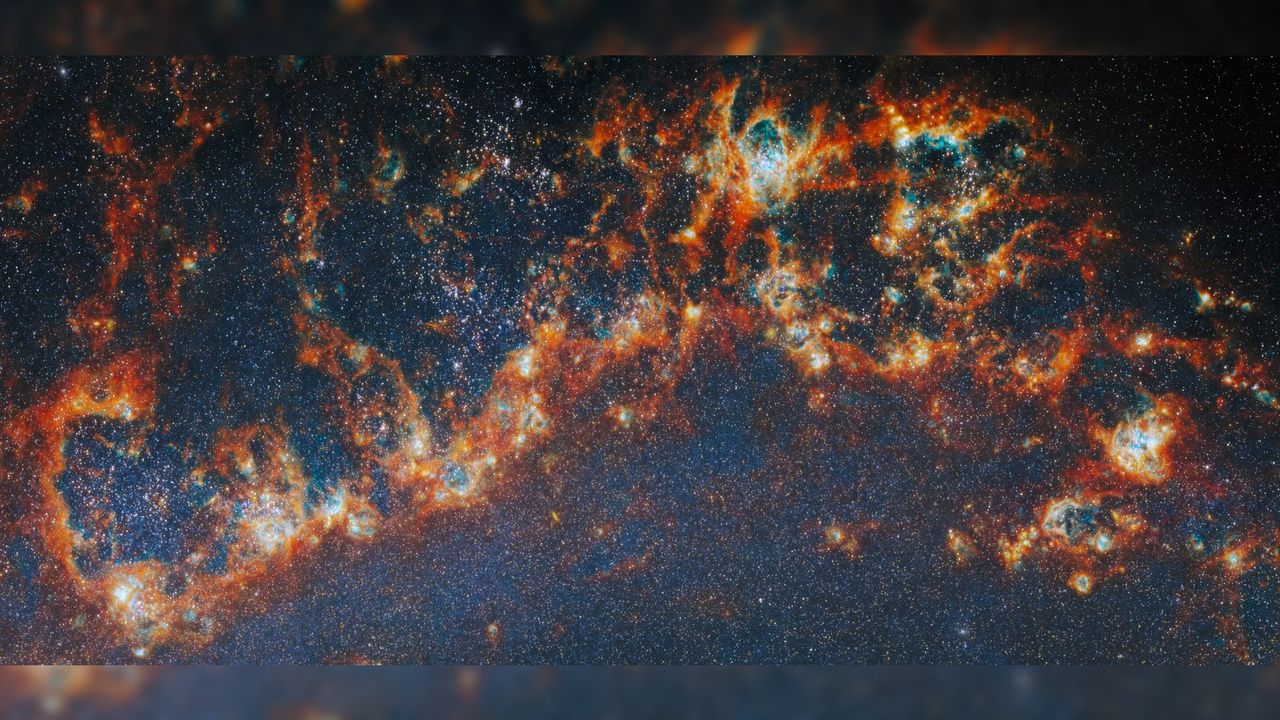
James Webb just photographed the Whirlpool Galaxy like never before, showing star-forming regions in stunning detail.
- James Webb Space Telescope releases new infrared image of M51
- Photo reveals star-forming regions and dust lanes in unprecedented detail
- Whirlpool Galaxy sits 23 million light-years from Earth
NASA’s James Webb Space Telescope just dropped a new image of M51, better known as the Whirlpool Galaxy, and it’s stunning. The infrared shot captures the galaxy’s iconic spiral arms with a level of detail scientists haven’t seen before. At 23 million light-years away, it’s one of the closest grand-design spiral galaxies to Earth, making it a prime target for deep-space study.
Why this image matters
The new photo isn’t just pretty—it’s packed with scientific value. Webb’s Mid-Infrared Instrument (MIRI) highlights warm dust in the galaxy’s spiral arms, where new stars are being born. Bright knots of light mark stellar nurseries, regions where gas and dust collapse under gravity to ignite stellar fusion. The dark lanes weaving through the spiral arms are dense molecular clouds, blocking light from behind them.
Astronomers love M51 because it’s interacting with a smaller companion galaxy, NGC 5195. That gravitational dance stirs up gas and triggers bursts of star formation. The new Webb image shows how these interactions sculpt the galaxy’s structure, offering clues about how galaxies evolve over time. It’s like watching a cosmic ballet in freeze-frame.
How Webb’s tech unlocked the details
Webb’s infrared sensors pick up heat signatures invisible to Hubble’s optical cameras. That’s why this image reveals so much more about the Whirlpool Galaxy’s hidden workings. The telescope’s 6.5-meter mirror and suite of instruments—including MIRI and the Near-Infrared Camera (NIRCam)—combine to cut through dust clouds that usually obscure these regions. The result is a sharper, deeper look at star formation than ever before.
Scientists will use this data to study how stars and planets form in dense molecular clouds. They’ll also compare it with older Hubble images to track changes over time. This isn’t just about one galaxy—it’s about understanding the life cycles of stars and galaxies across the universe. The Whirlpool Galaxy acts like a nearby lab for studying processes that happened in the early universe.
What’s next for M51 research
The Webb team plans to follow up with spectroscopic observations, breaking down the light from star-forming regions to analyze their chemical makeup. They’ll look for signatures of water, carbon dioxide, and other molecules critical to planet formation. Meanwhile, ground-based telescopes will continue monitoring M51 in radio and optical wavelengths to build a fuller picture of its dynamics.
This image proves Webb isn’t just rewriting astronomy textbooks—it’s giving us a front-row seat to the universe’s most dramatic processes. For stargazers and scientists alike, it’s a reminder of how much we still have to discover in our cosmic backyard.
What You Need to Know
- Source: Space.com
- Published: May 13, 2026 at 14:00 UTC
- Category: Science
- Topics: #space · #astronomy · #nasa · #science · #whirlpool-galaxy · #james-webb-space
Read the Full Story
This is a curated summary. For the complete article, original data, quotes and full analysis:
All reporting rights belong to the respective author(s) at Space.com. GlobalBR News summarizes publicly available content to help readers discover the most relevant global news.
Curated by GlobalBR News · May 13, 2026
Related Articles
- 5 Ways to Vet Social Media Health Advice Before Trying It
- Your Body Clock May Enhance The Benefits of Exercise, Study Finds
- Study finds yawns contagious before birth, even more than thought
🇧🇷 Resumo em Português
O telescópio James Webb acaba de nos presentear com uma imagem de tirar o fôlego da Galáxia do Redemoinho (M51), um espiral cósmico a 23 milhões de anos-luz da Terra, que agora pode ser admirada em detalhes nunca antes vistos pela humanidade.
A captura inédita, feita pelo supertelescópio da NASA, revela com nitidez regiões de formação estelar e faixas de poeira cósmica, oferecendo pistas valiosas sobre como galáxias espirais, como a Via Láctea, se estruturam e evoluem. Para o Brasil, que tem crescente participação em pesquisas astronômicas e programas de ciência espacial, essa descoberta reforça a importância de investimentos em tecnologia de ponta e colaboração internacional. Além disso, a imagem serve como inspiração para futuras gerações de cientistas e entusiastas do espaço, mostrando que o céu não é o limite quando se trata de explorar os mistérios do universo.
Em breve, novos dados do James Webb devem aprofundar nossa compreensão sobre a Galáxia do Redemoinho, enquanto aguardamos ansiosos pelas próximas revelações que podem redefinir o que sabemos sobre a formação das galáxias.
🇪🇸 Resumen en Español
El telescopio espacial James Webb ha vuelto a asombrar al mundo con una imagen sin precedentes de la galaxia del Remolino (M51), una espiral celeste que ahora se muestra con un detalle nunca visto antes.
Esta fotografía, captada en 2026, no solo ofrece una vista hipnótica de los brazos de la galaxia, sino que también revela con nitidez las regiones donde se gestan nuevas estrellas y los intrincados filamentos de polvo interestelar. Para los hispanohablantes, este avance científico no solo amplía el conocimiento sobre el universo, sino que refuerza el papel de la tecnología espacial en la exploración cósmica, un campo donde la colaboración internacional —y el idioma español— pueden jugar un papel clave en la divulgación y formación de futuras generaciones de científicos.
Space.com
Read full article at Space.com →This post is a curated summary. All rights belong to the original author(s) and Space.com.
Was this article helpful?


Discussion