Listen to Episode 210 of This Week In Space to hear Dr. Robert Lillis explain NASA’s ESCAPADE mission to Mars.
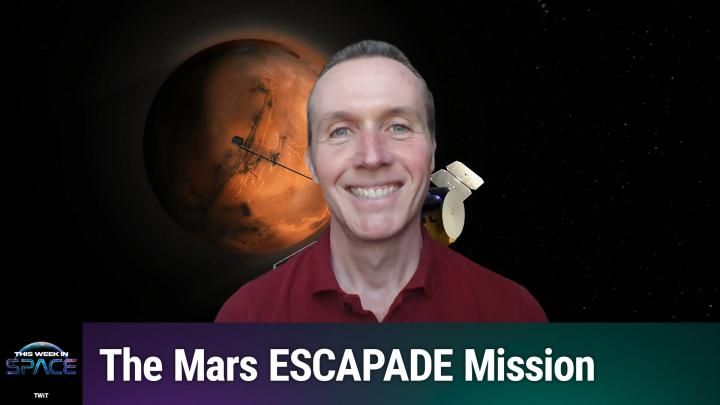
- NASA’s ESCAPADE mission features twin spacecraft heading to Mars
- Mission aims to study the Red Planet’s magnetosphere and atmosphere
- Dr. Robert Lillis leads the ESCAPADE mission team
NASA’s twin spacecraft for the ESCAPADE mission are en route to Mars, where they will study the planet’s magnetosphere and atmosphere. The mission, led by Dr. Robert Lillis, is the subject of Episode 210 of the This Week In Space podcast, hosted by Rod Pyle and Tariq Malik. The spacecraft, named Blue and Gold, are expected to arrive at Mars in 2025, where they will conduct joint observations to help scientists understand the planet’s climate history and the loss of its atmosphere over time.
The ESCAPADE mission is part of NASA’s Small Innovative Missions for Planetary Exploration program, designed to provide cost-effective, high-impact science. Each spacecraft is equipped with instruments to measure magnetic fields, ion densities, and solar wind interactions. This data will help researchers determine how Mars transitioned from a potentially habitable world to the cold, arid planet it is today.
Mission objectives and timeline
Dr. Lillis, a planetary scientist at the University of California, Berkeley, explained in the podcast that ESCAPADE aims to answer key questions about Mars’ atmospheric evolution. The spacecraft will enter orbit around Mars in September 2025, after a 10-month journey from Earth. Their observations will complement data from other Mars missions, including NASA’s MAVEN orbiter, which has been studying the planet’s atmosphere since 2014.
The mission’s primary goal is to measure the rate at which Mars’ atmosphere is escaping into space, a process driven by the sun’s interaction with the planet’s magnetic field. By studying these processes, scientists hope to reconstruct the history of Mars’ climate and assess whether the planet could have once supported life. The twin spacecraft will provide simultaneous measurements from different locations, offering a more comprehensive view than a single orbiter could.
Challenges and scientific impact
ESCAPADE faces several challenges, including the need for precise navigation to enter Mars orbit and the harsh radiation environment near the planet. The spacecraft were designed to operate autonomously, with minimal intervention from Earth, to ensure mission success. Their observations could redefine understanding of Mars’ atmospheric loss and provide clues about the planet’s potential habitability in the past.
The data collected by ESCAPADE will also support future human missions to Mars by improving models of the planet’s radiation environment. NASA and international partners are planning crewed missions to Mars in the coming decades, and understanding the planet’s atmospheric conditions is critical for astronaut safety. The mission’s findings could influence the design of habitats and protective measures for future explorers.
What’s next for ESCAPADE
After arriving at Mars in 2025, the ESCAPADE spacecraft will spend at least one Earth year conducting scientific observations. The mission team will continue to analyze data to refine models of Mars’ atmospheric escape processes. The results could have broader implications for the study of other planets, including Earth, by highlighting the role of magnetic fields in atmospheric retention.
The podcast episode provides a deep dive into the mission’s science goals, technical challenges, and the team’s preparations. Listeners can expect to hear firsthand insights from Dr. Lillis about the mission’s potential to rewrite textbooks on Mars’ history. The episode is available now on major podcast platforms, offering a timely update on one of NASA’s most ambitious Mars missions.
What You Need to Know
- Source: Space.com
- Published: May 16, 2026 at 14:43 UTC
- Category: Science
- Topics: #space · #astronomy · #nasa · #science · #episode · #mars
Read the Full Story
This is a curated summary. For the complete article, original data, quotes and full analysis:
All reporting rights belong to the respective author(s) at Space.com. GlobalBR News summarizes publicly available content to help readers discover the most relevant global news.
Curated by GlobalBR News · May 16, 2026
Related Articles
🇧🇷 Resumo em Português
A agência espacial norte-americana (NASA) está prestes a lançar uma missão ambiciosa para desvendar os mistérios da atmosfera de Marte, com potencial de impactar até mesmo a ciência brasileira. Chamada de ESCAPADE, a empreitada enviará dois satélites gêmeos ao Planeta Vermelho para analisar como seu campo magnético e partículas solares interagem com a fina camada gasosa que o envolve. A iniciativa, discutida recentemente no podcast This Week In Space, promete revelar pistas sobre a perda da atmosfera marciana ao longo de bilhões de anos — um fenômeno que intriga pesquisadores do mundo todo.
Para o Brasil, que tem ampliado sua presença no setor aeroespacial com projetos como o do satélite Amazônia-1 e parcerias internacionais, a missão ESCAPADE representa uma oportunidade de ouro para comparar dados em tempo real com outras missões, como a brasileira Marte 1 e as internacionais já em operação. Além disso, entender a dinâmica atmosférica de Marte pode ajudar a ciência local a desenvolver tecnologias mais precisas para futuras explorações espaciais, inclusive na busca por sinais de vida microbiana. A relevância também se estende à formação de novos cientistas e engenheiros brasileiros, que poderão se inspirar em projetos como esse para impulsionar a inovação no país.
Com o lançamento previsto para 2024, a missão ESCAPADE deve começar a enviar dados científicos dentro de alguns meses após a chegada a Marte, prevista para 2025, o que pode redefinir nossa compreensão sobre a história do planeta e, por tabela, sobre o futuro da exploração espacial como um todo.
🇪🇸 Resumen en Español
La NASA avanza en su ambiciosa exploración de Marte con la misión ESCAPADE, un proyecto que promete arrojar luz sobre los misterios de la atmósfera del planeta rojo. Dos naves gemelas, diseñadas para estudiar su interacción con el viento solar, han sido presentadas en el último episodio del podcast This Week In Space, consolidando el interés científico por desentrañar los secretos de un mundo que fascina tanto a investigadores como al público.
El lanzamiento de ESCAPADE, previsto para 2024, no solo representa un hito tecnológico al emplear cohetes comerciales para reducir costes, sino que también subraya la importancia de entender Marte más allá de su superficie. Para los hispanohablantes, este tipo de misiones refuerza el papel de la ciencia espacial como un campo global, donde el idioma no es barrera. Además, el estudio de la atmósfera marciana podría ayudar a descifrar cómo el planeta perdió gran parte de su agua, un conocimiento clave para futuras expediciones tripuladas y la posible colonización. La divulgación en español de estos avances, como en este podcast, democratiza el acceso a la información y acerca el cosmos a millones de personas.
Space.com
Read full article at Space.com →This post is a curated summary. All rights belong to the original author(s) and Space.com.
Was this article helpful?


Discussion