James Webb Telescope maps universe’s largest structure with unprecedented detail, tracing galaxies back 14 billion years.
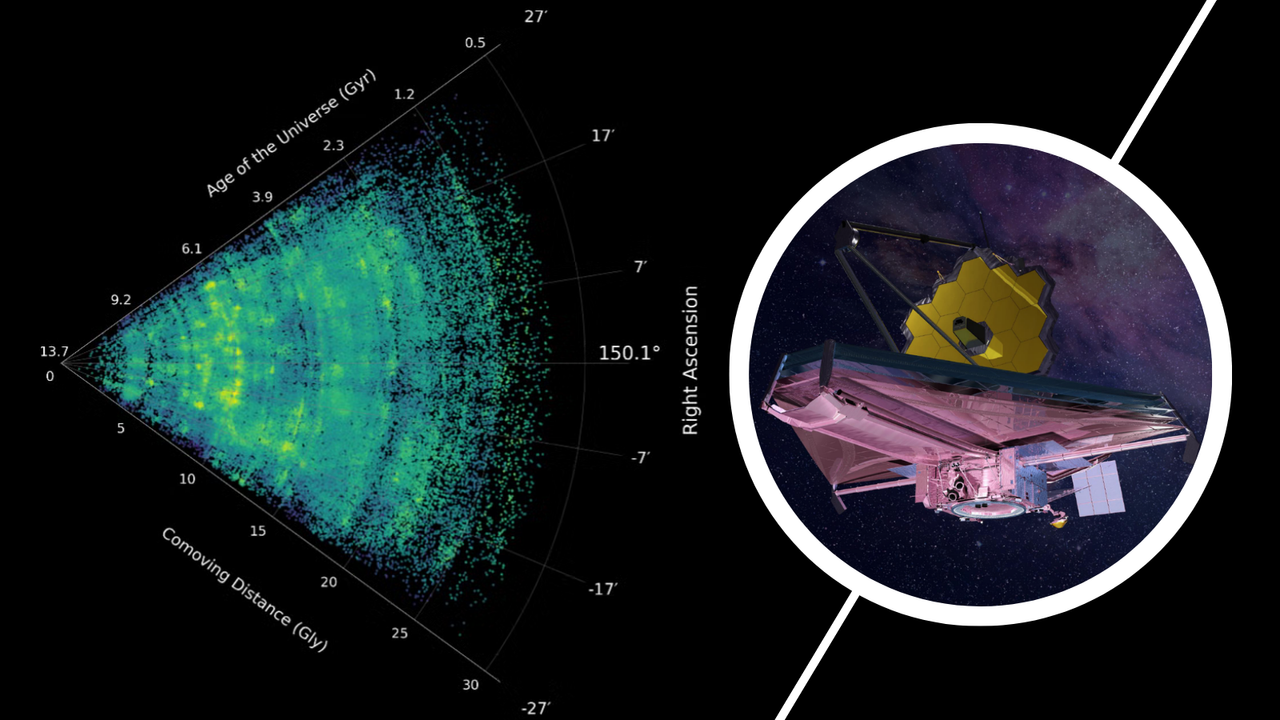
- James Webb Telescope maps cosmic web with unprecedented clarity
- Map traces galaxies back nearly 14 billion years in cosmic history
- Reveals dense clusters, filaments, and vast voids in the universe
Astronomers have used the James Webb Space Telescope to produce the most detailed map yet of the cosmic web, the universe’s largest structure. The new observations, part of the COSMOS-Web survey, reveal a vast network of galaxies, filaments, and voids stretching nearly 14 billion years into cosmic history.
The cosmic web is a web-like arrangement of galaxies and dark matter that forms the skeleton of the universe. For decades, astronomers have theorized about its structure, but the James Webb Telescope’s infrared capabilities have now provided an unparalleled view. The map shows bright yellow regions marking dense clusters and filaments, while dark areas represent near-empty voids between these cosmic highways.
Unprecedented Detail Reveals Ancient Galaxies
The COSMOS-Web survey, one of the largest James Webb programs, has captured galaxies as they appeared when the universe was less than a billion years old. By positioning each galaxy at its correct distance in cosmic time, the map offers a three-dimensional slice of the universe’s evolution. Researchers can now study how galaxies clustered together over billions of years, shedding light on the processes that shaped the cosmos.
The data reveals that the cosmic web’s structure has changed significantly over time. Early galaxies appear more scattered, while later structures show tighter clustering, reflecting the universe’s growth and the influence of dark matter. This map provides a key tool for testing theories about galaxy formation and the role of dark matter in shaping the universe.
How the James Webb Telescope Made This Discovery
The James Webb Space Telescope’s Near-Infrared Camera and Mid-Infrared Instrument captured infrared light from distant galaxies, allowing astronomers to peer through cosmic dust and see structures formed shortly after the Big Bang. The telescope’s sensitivity and resolution have made this level of detail possible for the first time.
The COSMOS-Web team, led by researchers at Rice University and the University of Toronto, plans to expand the survey to cover more of the sky. This will help astronomers refine their understanding of the cosmic web’s formation and evolution, as well as the role of dark energy in driving the universe’s expansion.
Broader Implications for Cosmology
This breakthrough has implications beyond mapping the cosmic web. It provides a new way to test models of dark matter and dark energy, the invisible components that make up most of the universe. By comparing the James Webb’s observations with simulations, scientists can refine their theories about how the universe evolved from a hot, dense state to the complex structure seen today.
The COSMOS-Web survey is just one of many projects using the James Webb Space Telescope to explore the early universe. As more data becomes available, astronomers expect to uncover further clues about the first galaxies, the formation of stars, and the ultimate fate of the cosmos. For now, this map stands as a landmark achievement in our quest to understand the universe’s largest structure.
What You Need to Know
- Source: Space.com
- Published: May 15, 2026 at 13:00 UTC
- Category: Science
- Topics: #space · #astronomy · #nasa · #science · #james-webb-space · #telescope
Read the Full Story
This is a curated summary. For the complete article, original data, quotes and full analysis:
All reporting rights belong to the respective author(s) at Space.com. GlobalBR News summarizes publicly available content to help readers discover the most relevant global news.
Curated by GlobalBR News · May 15, 2026
Related Articles
- 5 Ways to Vet Social Media Health Advice Before Trying It
- PCOS renamed to PMOS after decades of misdiagnosis confusion
🇧🇷 Resumo em Português
O telescópio James Webb acaba de revelar a maior estrutura do universo conhecida até hoje com um detalhe jamais visto, como se estivesse desvendando um gigante invisível tecido há quase 14 bilhões de anos. Em uma façanha que aproxima a humanidade do início do cosmos, cientistas mapearam a teia cósmica de galáxias — uma rede interconectada de matéria que forma o esqueleto do universo — com uma nitidez que surpreendeu até os pesquisadores mais céticos.
Essa descoberta não é apenas um marco para a astronomia, mas também carrega um significado profundo para o Brasil e os falantes de português, já que amplia nosso entendimento sobre a origem e a evolução do cosmos, um tema que sempre despertou curiosidade em todas as culturas. Além disso, o avanço reforça a importância de investimentos em ciência e tecnologia, mostrando como a cooperação internacional, como a parceria por trás do James Webb, pode nos levar a respostas sobre questões fundamentais: como tudo começou? Estamos sozinhos no universo? Para um país como o Brasil, que busca se consolidar na pesquisa espacial, essa janela para o passado cósmico serve como inspiração para novas gerações de cientistas e engenheiros.
Com essas imagens inéditas, os próximos passos incluem não só aprofundar o estudo dessas estruturas antigas, mas também preparar novas missões e tecnologias que possam desvendar ainda mais segredos do universo.
🇪🇸 Resumen en Español
El telescopio espacial James Webb ha logrado cartografiar la mayor estructura del universo conocida hasta ahora con un detalle sin precedentes, ofreciendo una ventana única a los primeros estadios de la formación galáctica.
Este avance, posible gracias a la capacidad infrarroja del instrumento, permite a los científicos retroceder casi 14.000 millones de años, desentrañando las redes cósmicas de galaxias que actuaron como esqueleto del cosmos. Para los hispanohablantes, no solo refuerza la posición de la astronomía española —que participa en el proyecto— en la vanguardia científica, sino que también inspira a nuevas generaciones a mirar hacia las estrellas con curiosidad, recordando que el universo guarda aún secretos por descifrar.
Space.com
Read full article at Space.com →This post is a curated summary. All rights belong to the original author(s) and Space.com.
Was this article helpful?

Discussion