Watch Venus grow into a brilliant crescent in the evening sky this May.
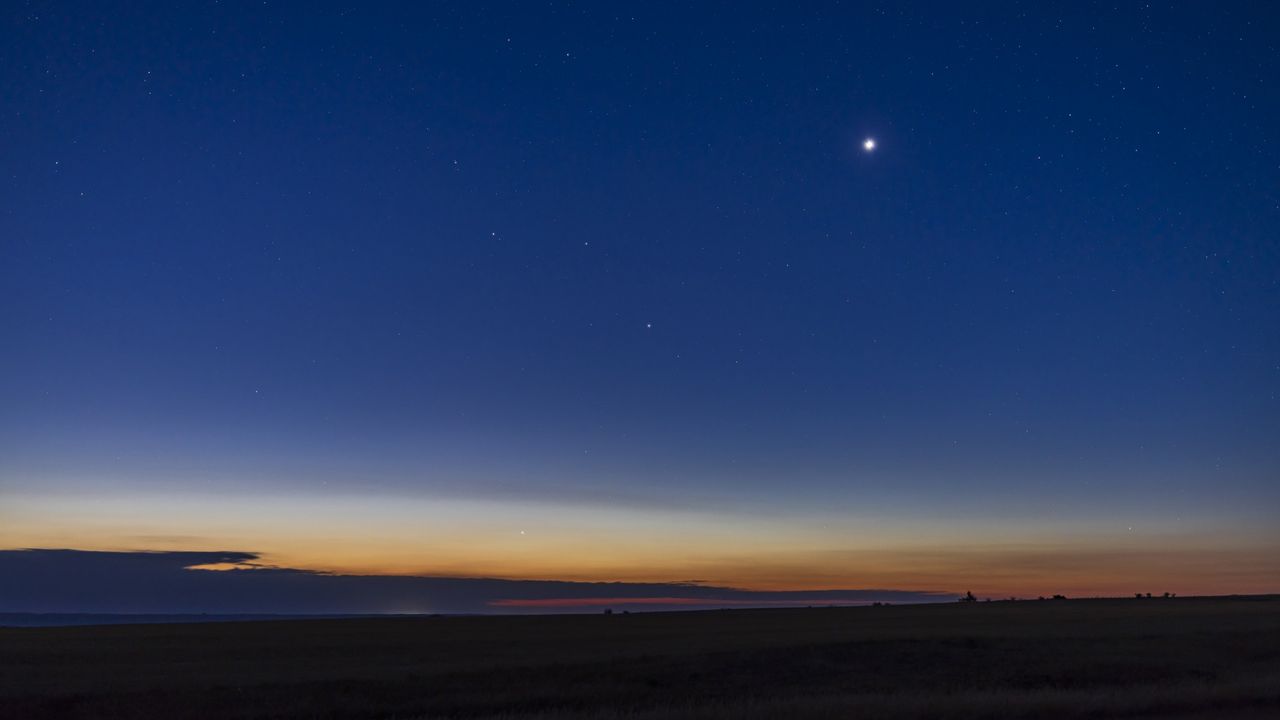
- Venus appears brightest in evening sky this May
- Planet is shifting into a striking crescent phase
- Moves closer to Earth, increasing brightness
Astronomers and stargazers are turning their eyes skyward this month as Venus blazes in the evening sky. The planet, which outshines all other celestial objects except the Moon, is now at its most visible phase of the year. Unlike distant stars, Venus reflects sunlight so intensely that it appears as a steady, brilliant point of light long after sunset. The planet’s brightness is peaking as it moves closer to Earth while transitioning from a gibbous phase to a thin crescent. This cycle repeats roughly every 19 months, but May offers prime viewing conditions before Venus dips lower in the sky later this summer.
Why Venus looks so bright right now
Venus currently reflects about 60 percent of the sunlight it receives, a phenomenon known as its albedo effect. As it orbits closer to Earth, its apparent size increases while the illuminated portion visible to us shrinks, creating a crescent shape. This combination makes Venus appear even brighter in the twilight sky. The planet’s thick, toxic atmosphere—composed mostly of carbon dioxide—also scatters sunlight, enhancing its luminosity. Skywatchers in urban areas with light pollution can still easily spot Venus without binoculars or telescopes.
The best time to observe Venus is in the first two hours after sunset. Look toward the western horizon where the planet will stand out against the fading glow of dusk. Unlike stars, Venus does not twinkle; its light remains steady, making it unmistakable. Astronomers recommend checking the sky between May 10 and May 20, when Venus reaches its greatest eastern elongation, appearing farthest from the Sun in our view. This positioning keeps the planet visible for nearly four hours after sunset.
Constellations and companions in the May sky
While Venus commands attention, the southern sky offers another treat this month: Corvus, the crow, a small but distinct kite-shaped constellation. Located near the bright star Spica in Virgo, Corvus is visible from most latitudes in the Northern Hemisphere. The constellation’s four main stars form a recognizable trapezoid shape, making it a favorite for amateur astronomers. Venus will drift closer to Spica by late May, creating a striking pairing of bright objects in the evening sky.
How to photograph Venus this month
Photographers can capture stunning images of Venus using a standard DSLR camera with a telephoto lens. Attach the camera to a tripod and set the exposure for at least 1/30th of a second to avoid blurring. Venus’s brightness allows for high-contrast shots even in low light. For close-up detail, a telescope with a smartphone adapter can reveal the planet’s crescent shape. Clear nights between May 15 and 25 will provide the best opportunities before Venus begins to sink lower in the sky.
Venus’s brilliance will gradually fade in June as it moves between Earth and the Sun, a phase known as inferior conjunction. After this, it will re-emerge in the morning sky as the “Morning Star” in late summer. Until then, May offers the last chance for evening viewers in the Northern Hemisphere to witness Venus at its peak. The planet’s regular cycles mean this dazzling display will not return until early 2025. For now, astronomers and casual observers alike can enjoy one of the most spectacular planetary shows of the year.
What You Need to Know
- Source: Space.com
- Published: May 14, 2026 at 13:00 UTC
- Category: Science
- Topics: #space · #astronomy · #nasa · #science · #venus · #venus-in-evening-sky-may-2024
Read the Full Story
This is a curated summary. For the complete article, original data, quotes and full analysis:
All reporting rights belong to the respective author(s) at Space.com. GlobalBR News summarizes publicly available content to help readers discover the most relevant global news.
Curated by GlobalBR News · May 14, 2026
Related Articles
🇧🇷 Resumo em Português
O mês de maio reserva um espetáculo celestial imperdível para os brasileiros: Vênus, o planeta mais brilhante do céu noturno, atingirá seu pico de visibilidade ao entardecer, oferecendo um show de luz que pode ser observado a olho nu em todo o país. Durante as noites de maio, o astro se destacará como um farol cintilante logo após o pôr do sol, proporcionando um momento único para entusiastas da astronomia e curiosos observarem sua fase de crescente — um fenômeno que só ocorre periodicamente e que pode ser visto sem a necessidade de telescópios.
A relevância dessa aparição vai além do simples encantamento visual: Vênus, o segundo planeta do Sistema Solar, tem chamado a atenção de cientistas não só por sua beleza, mas também por suas condições extremas, com temperaturas capazes de derreter chumbo e uma atmosfera tóxica composta principalmente de dióxido de carbono. Para o Brasil, onde a popularização da astronomia tem ganhado força com iniciativas como a Olimpíada Brasileira de Astronomia e Astronáutica (OBA), a oportunidade de observar o planeta em sua máxima luminosidade serve como um incentivo para engajar estudantes e o público em geral no estudo das ciências espaciais. Além disso, o fenômeno reforça a importância de investimentos em pesquisa e educação científica, áreas que podem contribuir para o desenvolvimento tecnológico do país.
Quem perder a chance de contemplar Vênus nesta semana ainda terá oportunidades em junho, mas a visibilidade não será tão intensa — por isso, bastam alguns minutos após o anoitecer para garantir um momento memorável sob o céu brasileiro.
🇪🇸 Resumen en Español
Venus despliega este mes su máximo esplendor en el cielo nocturno, ofreciendo un espectáculo astronómico sin igual.
Durante las tardes de mayo, el planeta más cercano a la Tierra brillará con una intensidad inusual tras la puesta de sol, alcanzando su máximo brillo anual. Este fenómeno, observable a simple vista, se debe a su posición relativa al Sol y a su densa capa de nubes reflectantes, que intensifican su luminosidad. Para los aficionados a la astronomía y el público en general, es una oportunidad única para admirar su fase creciente —similar a la de la Luna— y entender por qué Venus, a pesar de no ser el más grande, es el astro más brillante después del Sol y la Luna.
Space.com
Read full article at Space.com →This post is a curated summary. All rights belong to the original author(s) and Space.com.
Was this article helpful?
Discussion