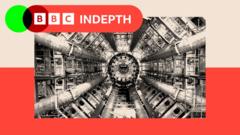
UK risks losing its edge in particle physics by pulling funding from a major Large Hadron Collider upgrade.
- UK plans to cancel £60 million contribution to particle collider upgrade
- Move follows 2012 Higgs boson discovery with UK involvement
- Scientists call cuts 'catastrophic' for UK physics reputation
The UK’s Science and Technology Facilities Council Science_and_Technology_Facilities_Council confirmed plans to pull its £60 million share of funding for the High-Luminosity Large Hadron Collider (HL-LHC) upgrade. The project, costing €2.5 billion, aims to boost the particle collider’s power tenfold by 2029, letting scientists smash protons together at even higher speeds. Without UK money, the project’s future is uncertain—and physics leaders say Britain’s reputation is on the line.
The decision reverses decades of British investment in the European Organization for Nuclear Research CERN, where UK scientists played a key role in discovering the Higgs boson in 2012. Physicists warn the cuts could force top researchers abroad and leave the UK trailing in fields like quantum computing and medical imaging. “This isn’t just about money—it’s about losing our place at the table,” said Brian Foster, a particle physicist at the University of Oxford.
Why the Higgs boson discovery matters
The Higgs boson, often called the ‘God particle,’ explains why other particles have mass. UK scientists were central to the 2012 breakthrough, which won the Nobel Prize in Physics the next year. The discovery cemented Britain’s role as a leader in particle physics, but now that leadership is under threat. The HL-LHC upgrade would have let researchers probe deeper into the universe’s mysteries, like dark matter and antimatter. Without it, UK physicists risk missing out on the next big discovery.
The cuts come as the UK government faces tight budgets and competing demands for science funding. The Science and Technology Facilities Council argues the money could be better spent elsewhere, but critics say the move reflects a short-term mindset. “We’re trading long-term gains for short-term savings,” said Jim Al-Khalili, a physicist at the University of Surrey. The UK’s physics community is now rallying to reverse the decision, with petitions and letters to ministers.
What happens next for UK physics
If the UK pulls out, other countries like Germany and Japan are likely to step in to fill the funding gap. But losing British expertise would slow the project’s progress. The HL-LHC isn’t just about prestige—it’s about keeping the doors open for the next generation of physicists. “This is where students train, where breakthroughs happen,” said Tara Shears, a professor at the University of Liverpool. “Walk away now, and we’ll watch from the sidelines.”
The decision also raises questions about the UK’s commitment to big science projects. The country has already left the EU’s flagship Horizon Europe research program after Brexit, cutting off billions in funding. Now, physicists fear the cuts to CERN could be just the start. “We’re sending a message that the UK isn’t a reliable partner,” said Jon Butterworth, a physicist at University College London. “That’s bad for science—and bad for the economy too.”
What’s clear is that the UK’s physics reputation is on the line. The Higgs boson discovery proved Britain could compete at the highest level, but now the question is whether it’s willing to pay to stay there. For now, the country’s physicists are fighting to keep their seat at the table.
What You Need to Know
- Source: BBC News
- Published: March 18, 2026 at 19:40 UTC
- Category: Environment
- Topics: #bbc · #environment · #climate · #science · #physics · #higgs
Read the Full Story
This is a curated summary. For the complete article, original data, quotes and full analysis:
All reporting rights belong to the respective author(s) at BBC News. GlobalBR News summarizes publicly available content to help readers discover the most relevant global news.
Curated by GlobalBR News · March 18, 2026
Related Articles
🇧🇷 Resumo em Português
O Reino Unido, que há uma década ajudou a desvendar o famoso bóson de Higgs, agora corre o risco de cortar investimentos essenciais para a física global. O governo britânico anunciou a intenção de reduzir sua participação em um upgrade crucial do Grande Colisor de Hádrons (LHC), o maior acelerador de partículas do mundo, localizado na fronteira entre Suíça e França. A decisão, ainda em análise, pode não apenas minar décadas de colaboração científica internacional, mas também deixar o país para trás em descobertas revolucionárias que moldam o futuro da tecnologia e da medicina.
O impacto dessa possível redução de verbas vai muito além das fronteiras europeias, com reflexos diretos no Brasil e em toda a comunidade científica de língua portuguesa. O LHC, operado pela Organização Europeia para a Pesquisa Nuclear (CERN), é um laboratório de ponta que atrai pesquisadores de todo o mundo, inclusive brasileiros, muitos deles financiados por agências nacionais como o CNPq e a FAPESP. A saída do Reino Unido do projeto, que já enfrenta cortes orçamentários desde 2020, pode frear colaborações essenciais em áreas como energia limpa, computação quântica e tratamento de doenças. Além disso, o Reino Unido é um dos principais parceiros do Brasil em ciência e inovação, e a decisão enfraqueceria laços estratégicos em um momento em que o país busca ampliar sua inserção internacional na pesquisa de ponta.
Caso o governo britânico confirme os cortes, a comunidade científica global terá de se adaptar rapidamente, buscando novas fontes de financiamento ou reavaliando prioridades de pesquisa.
BBC News
Read full article at BBC News →This post is a curated summary. All rights belong to the original author(s) and BBC News.
Was this article helpful?



Discussion