Ethiopian woman delivers five babies after 12-year infertility struggle.
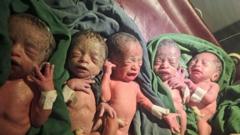
- Doctors confirm quintuplets born in Addis Ababa hospital
- Mother underwent years of infertility treatments
- High-risk pregnancy monitored closely by medical team
An Ethiopian woman, 35, delivered five babies on Wednesday at a hospital in Addis Ababa after a 12-year wait for a child, her doctors announced. The rare multiple birth occurred via planned cesarean section at Tikur Anbessa Specialized Hospital, one of Ethiopia’s largest medical centers. Medical staff confirmed the healthy delivery of three boys and two girls, weighing between 1.2 and 1.8 kilograms each. The mother, identified only as Mrs. Alemu, said she was “overjoyed” after years of infertility treatments and repeated disappointment. “I prayed every day for this moment,” she told reporters outside the hospital. “I never lost hope, even when doctors said it might not happen.”
Medical team hails rare birth as a success
Doctors at Tikur Anbessa Specialized Hospital described the quintuplet delivery as a medical success despite the high risks associated with multiple births. Dr. Kebede Worku, head of obstetrics, said Mrs. Alemu had undergone fertility treatments for over a decade, including hormone therapy and ovulation induction. “This case required close monitoring from the start,” Worku said. “We adjusted her treatment plan multiple times to reduce complications.” Ethiopia has one of the highest maternal mortality rates in the world, according to World Health Organization data, making such high-risk pregnancies particularly challenging. The hospital reported no immediate complications for the mother or babies, who are in stable condition under neonatal care.
Fertility treatments and maternal health in Ethiopia
Experts say infertility affects about 15% of couples in sub-Saharan Africa, with limited access to advanced reproductive technologies. Mrs. Alemu’s journey reflects the struggles of many women in the region who face stigma and financial barriers while seeking fertility treatments. “I sold livestock and borrowed money to pay for my treatments,” she said. “But I never gave up.” Her case highlights broader challenges in Ethiopia’s healthcare system, where rural women often lack access to specialists. The government has expanded maternal health programs in recent years, but infertility remains underfunded and stigmatized.
Global rarity of quintuplet births
Quintuplet births are exceptionally rare, occurring in roughly 1 in 55 million pregnancies worldwide, according to medical literature. The most famous recent case occurred in 2021 in Morocco, where a woman delivered five babies after fertility treatments. In Ethiopia, only a handful of such births have been documented in the past two decades. Dr. Worku noted that multiple births carry higher risks of preterm delivery, low birth weight, and developmental delays, but early intervention helped ensure positive outcomes for Mrs. Alemu’s babies.
Mrs. Alemu’s story has drawn local and international attention, with many praising her perseverance. Community leaders in Addis Ababa have organized support for her family, including donations for medical expenses. The hospital plans to monitor the babies’ progress closely over the coming months. For now, Mrs. Alemu said she is focused on recovery and bonding with her children. “They are my miracle,” she said. “I will cherish every moment.”
Ethiopia’s health ministry is reviewing the case to assess any lessons for future high-risk pregnancies in the country.
What You Need to Know
- Source: BBC News
- Published: May 08, 2026 at 06:48 UTC
- Category: Health
- Topics: #bbc · #health · #medicine · #ethiopian · #ethiopia-quintuplets · #multiple-birth-ethiopia
Read the Full Story
This is a curated summary. For the complete article, original data, quotes and full analysis:
All reporting rights belong to the respective author(s) at BBC News. GlobalBR News summarizes publicly available content to help readers discover the most relevant global news.
Curated by GlobalBR News · May 08, 2026
Related Articles
- Midlife fitness boosts lifespan and health by 5+ years study finds
- Why ‘Ballmaxxing’ May Be More Dangerous Than You Think
- Weight Loss Surgeries Decline as GLP-1 Use Skyrockets. Why This Matters
🇧🇷 Resumo em Português
Uma mãe etíope de 35 anos realizou o sonho de ter filhos após 12 anos de espera, dando à luz cinco bebês em um parto raro e de alto risco que emocionou o país. O nascimento dos gêmeos, trigêmeos e um quinto filho, confirmado por médicos, é um marco não apenas na vida da família, mas também na saúde reprodutiva da região, onde casos de múltiplos nascimentos são raros e desafiam os sistemas locais de assistência médica.
Segundo especialistas, a gravidez múltipla, embora comemorada, representa um desafio significativo em países como a Etiópia, onde o acesso a cuidados pré-natais especializados e unidades de terapia intensiva neonatal ainda é limitado. O caso levanta discussões sobre a necessidade de ampliar o suporte à saúde materna e infantil, especialmente em regiões com recursos escassos, onde gestações de alto risco muitas vezes resultam em desfechos trágicos. Para o Brasil, país com realidades semelhantes em algumas áreas, o episódio serve como reflexão sobre a importância do planejamento familiar e do acompanhamento médico adequado.
A história da mãe etíope deve inspirar campanhas de conscientização sobre infertilidade e opções de tratamento, enquanto os próximos meses serão cruciais para acompanhar o desenvolvimento dos bebês e o suporte oferecido à família.
🇪🇸 Resumen en Español
Una mujer etíope de 35 años ha roto récords médicos al dar a luz a cinco bebés tras doce años de lucha contra la infertilidad.
El parto, calificado de alto riesgo por los especialistas, ha sorprendido a los facultativos por su rareza, ya que múltiples nacimientos de esta magnitud son excepcionales. La noticia ha generado tanto admiración como preocupación por la salud materna e infantil en contextos con recursos sanitarios limitados, subrayando la importancia de un seguimiento médico especializado. Para el público hispanohablante, este caso sirve como recordatorio de los avances en reproducción asistida, pero también plantea debates éticos y económicos sobre tratamientos de fertilidad en sistemas públicos.
BBC News
Read full article at BBC News →This post is a curated summary. All rights belong to the original author(s) and BBC News.
Was this article helpful?


Discussion