Israel kills Hamas commander Izz ad-Din al-Haddad in Gaza airstrike, military confirms.
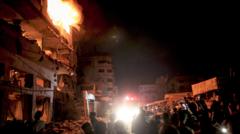
- Israel says it killed Hamas commander Izz ad-Din al-Haddad in Gaza strike
- Haddad described as architect of October 7 attacks by Israel
- Strike targeted Gaza City, military confirms
Israel’s military announced late Thursday that it had killed Izz ad-Din al-Haddad, a senior Hamas commander, in an airstrike on Gaza City. The Israel Defense Forces (IDF) identified Haddad as one of the architects behind the October 7 attacks that killed about 1,200 people and triggered the ongoing war in Gaza.
The IDF stated in a social media post that Haddad was targeted due to his role in planning and executing attacks against Israeli civilians. According to the military, Haddad was a member of Hamas’s military wing, the Qassam Brigades, and had been involved in coordinating rocket attacks and infiltration operations.
Hamas leadership remains a primary target
The strike is part of Israel’s continued campaign against Hamas leadership in Gaza, which has intensified since the October 7 attacks. Israel has repeatedly targeted senior Hamas figures, including Mohammed Deif, the leader of the Qassam Brigades, who was reportedly killed in a July airstrike. Hamas has not yet confirmed Haddad’s death or responded to Israel’s claim.
Gaza health officials have not yet commented on civilian casualties from the strike. The ongoing conflict has led to significant destruction and loss of life in Gaza, with over 38,000 Palestinians killed, according to local authorities. The IDF has not provided details on collateral damage from the strike.
International reactions and ongoing tensions
The announcement comes amid heightened tensions in the region, with recent exchanges of fire between Israel and Hezbollah in Lebanon, as well as continued clashes in the West Bank. The U.S. and other Western nations have reiterated their support for Israel’s right to defend itself while calling for restraint to avoid further civilian casualties.
The IDF’s targeting of Hamas commanders follows a broader strategy to degrade the group’s military capabilities. Israeli officials have stated that such operations are necessary to prevent future attacks on Israeli territory. The war in Gaza, now in its ninth month, has drawn widespread international concern over humanitarian conditions and the displacement of millions of Palestinians.
As of now, Hamas has not issued a formal response to the claim of Haddad’s death. The group’s military wing, the Qassam Brigades, typically acknowledges the deaths of its commanders in official statements or funerals. The absence of such a statement raises questions about the accuracy of Israel’s claim, though it does not rule out confirmation in the coming hours or days.
The strike on Haddad underscores the ongoing intensity of the conflict and the high stakes for both sides. With negotiations for a ceasefire stalled and humanitarian conditions worsening in Gaza, the targeting of senior Hamas figures remains a contentious and high-risk strategy.
What You Need to Know
- Source: BBC News
- Published: May 15, 2026 at 19:38 UTC
- Category: World
- Topics: #bbc · #world-news · #international · #war · #gaza · #middle-east
Read the Full Story
This is a curated summary. For the complete article, original data, quotes and full analysis:
All reporting rights belong to the respective author(s) at BBC News. GlobalBR News summarizes publicly available content to help readers discover the most relevant global news.
Curated by GlobalBR News · May 15, 2026
Related Articles
- US proposes 40% cut in Colorado River water for 3 states amid drought
- Trump urges Taiwan to avoid independence amid rising China tensions
- Xi gives Trump private tour of secret garden in Beijing
🇪🇸 Resumen en Español
El ejército israelí ha confirmado la eliminación de un alto mando de Hamás en un bombardeo selectivo en Gaza, un golpe estratégico que reaviva las tensiones en la región tras meses de conflicto. La operación, que según fuentes militares habría acabado con Izz ad-Din al-Haddad —considerado uno de los cerebros detrás de los ataques del 7 de octubre—, marca un nuevo capítulo en la escalada de violencia que ya ha dejado miles de víctimas en el enclave palestino.
El anuncio llega en un momento crítico, cuando la comunidad internacional intensifica los llamamientos a un alto el fuego duradero, mientras Israel insiste en su derecho a perseguir a los responsables de los atentados que conmocionaron al mundo. Para los hispanohablantes, la noticia resuena con especial fuerza por el creciente flujo de información en medios de comunicación en español, que han reflejado tanto el sufrimiento de la población gazatí como la postura israelí. La operación, sin embargo, plantea interrogantes sobre las consecuencias humanitarias y el riesgo de una espiral de represalias en un territorio ya devastado por la guerra.
BBC News
Read full article at BBC News →This post is a curated summary. All rights belong to the original author(s) and BBC News.
Was this article helpful?

Discussion