SpaceX launched 6,500 pounds of cargo to the ISS on May 15 after a weather delay.
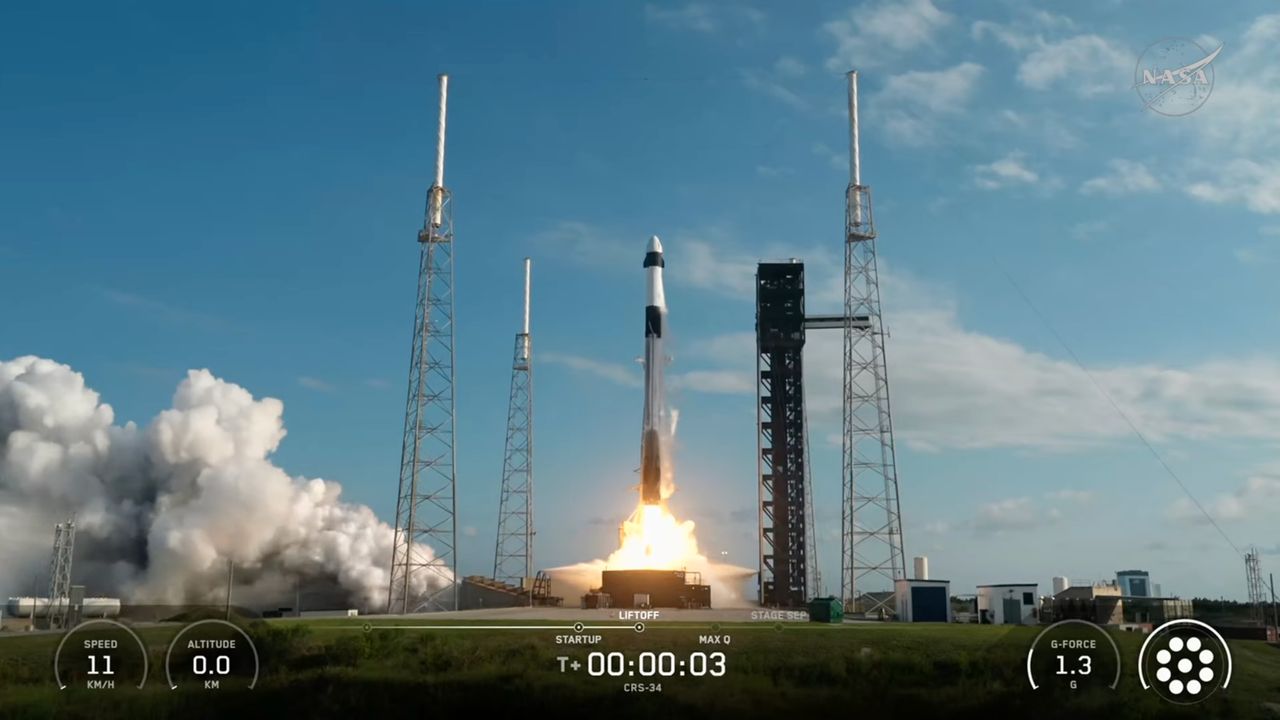
- SpaceX launched 6,500 pounds of cargo to ISS on May 15
- Mission delayed by weather before successful liftoff
- Dragon capsule carries supplies for NASA’s resupply mission
📰 Continuing coverage: SpaceX launches NASA cargo mission to ISS with 6,500 lbs of supplies
A SpaceX Dragon cargo capsule rocketed toward the International Space Station Thursday, carrying 6,500 pounds of supplies, science experiments and hardware for the orbiting lab. The launch from Cape Canaveral Space Force Station in Florida came after a 24-hour delay caused by poor weather conditions. The mission, designated CRS-34 under NASA’s Commercial Resupply Services contract, is the 34th such flight operated by SpaceX for the agency. The Dragon spacecraft is expected to dock with the ISS on Saturday, delivering critical materials for ongoing research and station maintenance. The cargo includes fresh food, new science investigations and replacement hardware for the station’s systems. This marks SpaceX’s 13th mission to the ISS in 2026 alone, underscoring the company’s role as a primary logistics provider for low-Earth orbit operations.
Mission proceeds after weather rules scrub first attempt
The launch attempt Wednesday was called off just minutes before liftoff due to elevated winds and unfavorable conditions in the ascent corridor. SpaceX and NASA delayed the mission to Thursday, when weather improved enough for a safe launch. The Falcon 9 rocket lifted off at 4:45 p.m. EDT, arcing over the Atlantic Ocean as it climbed toward orbit. The first stage booster separated two minutes after launch and executed a controlled landing at SpaceX’s Landing Zone 1 at Cape Canaveral. This was the ninth flight for this particular booster, which has previously supported multiple missions, including two prior ISS resupply flights. The successful landing adds to SpaceX’s growing fleet of reusable rockets, which continues to reduce launch costs for NASA and commercial customers. Mission controllers monitored the ascent from SpaceX’s headquarters in Hawthorne, California.
Cargo includes cutting-edge experiments and vital supplies
The Dragon capsule is packed with 6,500 pounds of pressurized cargo, including 2,000 pounds of scientific equipment and experiments. Among the payloads is a new batch of European Space Agency research gear designed to study the effects of microgravity on plant growth. NASA’s Human Research Program sent equipment to monitor crew health, including radiation detectors and exercise hardware upgrades. The cargo also includes spare parts for the station’s life support systems and a new air filtration unit. Engineers at NASA’s Johnson Space Center will oversee the cargo transfer once the Dragon docks to the Harmony module on Saturday. After a month-long stay, the capsule will depart the station loaded with 3,200 pounds of return cargo, including completed experiments and waste materials.
SpaceX maintains steady cadence of ISS resupply missions
The CRS-34 mission continues SpaceX’s uninterrupted string of cargo deliveries to the ISS, which began in 2012. The company has flown more than 30 resupply missions under the $3.1 billion NASA contract, transporting over 100,000 pounds of cargo to the station. SpaceX’s Dragon is currently the only cargo vehicle capable of returning significant amounts of research and hardware to Earth, a critical capability for the ISS program. The company’s next resupply mission, CRS-35, is scheduled for August 2026. NASA officials highlighted the reliability of SpaceX’s Dragon and Falcon 9 systems, noting that no cargo has been lost in transit since the program’s inception. The successful launch Thursday also sets the stage for upcoming crewed missions, including the planned Crew-9 rotation later this year.
The broader implications of this mission extend beyond the immediate delivery of supplies. The continued success of commercial resupply services demonstrates the viability of public-private partnerships in space exploration. NASA’s reliance on companies like SpaceX has enabled the agency to focus on long-duration missions to the moon and Mars while maintaining a steady presence in low-Earth orbit. The cargo delivered Thursday will support dozens of experiments already underway on the station, including studies in biology, physics and human health. As the ISS nears the end of its operational lifespan, missions like CRS-34 ensure that the orbital laboratory remains a hub for scientific discovery and technological innovation.
What You Need to Know
- Source: Space.com
- Published: May 12, 2026 at 15:00 UTC
- Category: Science
- Topics: #space · #astronomy · #nasa · #science · #dragon · #spacex-launch-may-15
Read the Full Story
This is a curated summary. For the complete article, original data, quotes and full analysis:
All reporting rights belong to the respective author(s) at Space.com. GlobalBR News summarizes publicly available content to help readers discover the most relevant global news.
Curated by GlobalBR News · May 12, 2026
Related Articles
- 5 Ways to Vet Social Media Health Advice Before Trying It
- Your Body Clock May Enhance The Benefits of Exercise, Study Finds
🇧🇷 Resumo em Português
O Brasil, que recentemente ampliou sua participação em missões espaciais através de parcerias com agências internacionais, acompanha com entusiasmo mais um marco da exploração espacial: a SpaceX realizou com sucesso o lançamento de uma nave Dragon carregando 2,9 toneladas de suprimentos para a Estação Espacial Internacional (ISS), na manhã de 15 de maio de 2026, após um adiamento causado pelo mau tempo. A missão, que partiu do Centro Espacial Kennedy, na Flórida, reforça a dependência crescente da humanidade em relação ao transporte privado de cargas para manter a presença contínua no laboratório orbital.
O envio de mantimentos, equipamentos científicos e tecnologias para a ISS é fundamental não apenas para a sobrevivência dos astronautas em órbita, mas também para viabilizar experimentos que podem trazer avanços para áreas como medicina, agricultura e materiais no Brasil. Com o país integrando projetos de pesquisa espacial cada vez mais ambiciosos, como a participação no programa Artemis, cada missão como esta abre portas para que cientistas brasileiros tenham acesso a dados e inovações geradas em ambiente de microgravidade, essenciais para o desenvolvimento de soluções nacionais.
Agora, a Dragon deve atracar na ISS dentro de dois dias, enquanto a SpaceX e a NASA já planejam os próximos lançamentos, que prometem incluir mais colaborações internacionais — um sinal claro de que o futuro da ciência espacial será cada vez mais colaborativo e acessível.
🇪🇸 Resumen en Español
La madrugada del 15 de mayo de 2026 marcó un hito en la exploración espacial cuando SpaceX logró lanzar con éxito una nave de carga Dragon con 2.900 kilos de suministros rumbo a la Estación Espacial Internacional, tras superar un retraso por condiciones meteorológicas adversas.
La misión, que reabastecerá a la tripulación en órbita con alimentos, equipos científicos y tecnología, refuerza el papel clave de las empresas privadas en la logística espacial y subraya la creciente colaboración internacional en este ámbito. Para los hispanohablantes, destaca el impacto de estos avances en sectores como la medicina, la agricultura o las telecomunicaciones, donde la investigación en ingravidez puede traducirse en soluciones tangibles para la vida cotidiana. Además, refleja cómo España y Latinoamérica, aunque con menor presencia en el sector, podrían beneficiarse de estos avances en áreas como la formación de astronautas o el desarrollo de satélites.
Space.com
Read full article at Space.com →This post is a curated summary. All rights belong to the original author(s) and Space.com.
Was this article helpful?

Discussion