New study finds Uranus and Neptune could be rock-filled under their atmospheres, reshaping planet formation theories.
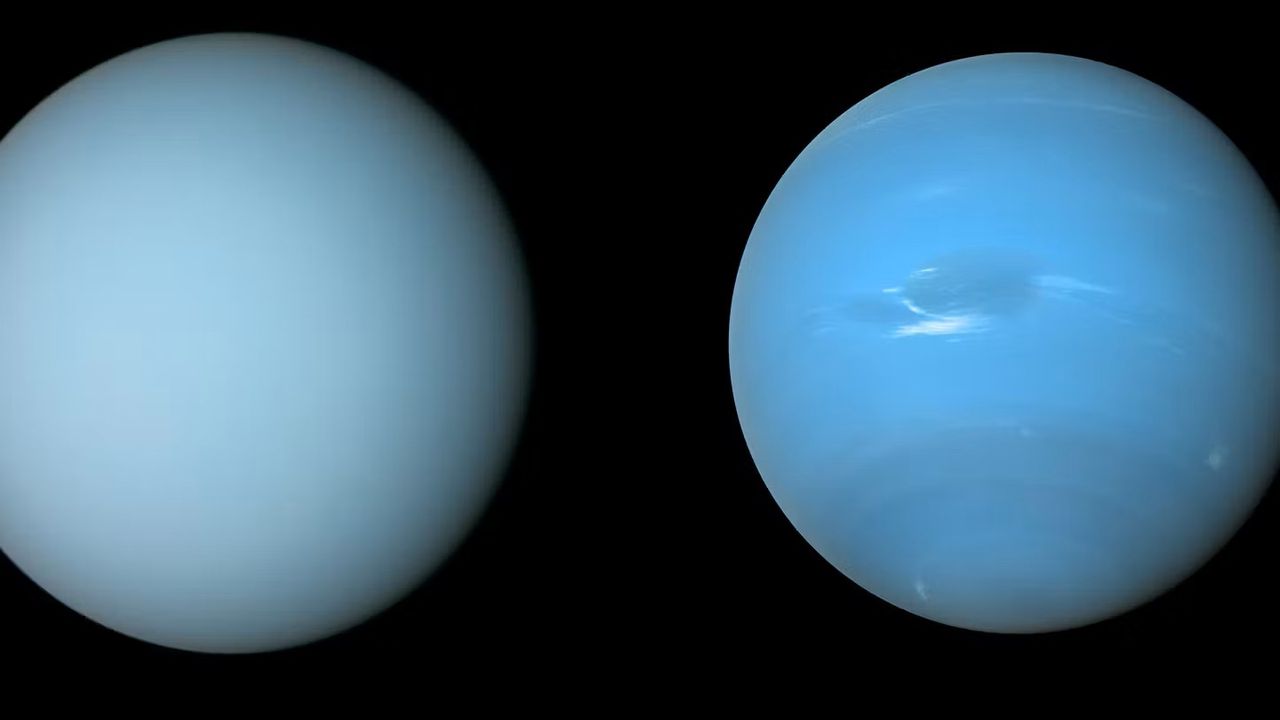
- Researchers propose rocky cores beneath Uranus and Neptune's atmospheres
- Findings challenge traditional views of ice giant composition
- Study suggests planets may have formed differently than thought
The outer planets Uranus and Neptune may not be as icy as once believed. A new study published in Nature Astronomy suggests their interiors could be dominated by rock rather than ice, upending decades of planetary science assumptions. Researchers from Arizona State University conducted simulations showing that the traditional ice giant model may oversimplify the planets’ compositions.
New evidence challenges old models
The long-held view has been that Uranus and Neptune are composed primarily of water, ammonia, and methane ices. This new research indicates that their rocky cores could be far more substantial than previously thought. Scientists used updated thermodynamic data to model the planets’ interiors, finding that rock may account for up to 90% of their total mass in some scenarios. “The distinction between ice giants and terrestrial planets isn’t as clear as we thought,” said lead researcher Carver Bierson, a planetary scientist at Arizona State University.
The findings emerged from re-examining how planets form in the outer solar system. Traditional models suggest that ice giants formed from icy planetesimals accumulating around rocky cores. However, the new study proposes that these planets may have formed directly from rocky materials under different conditions. If correct, this would mean Uranus and Neptune are not true ice giants but rather gas-covered rocky worlds.
How the study changes planetary science
The research relies on revised equations of state for planetary materials under extreme pressures and temperatures. Previous models underestimated the density of rock under such conditions, leading to the assumption that ice was the primary component. The new calculations show that rock can achieve similar densities to ice at the pressures found deep within these planets, making it a plausible dominant material.
This challenges not just the classification of Uranus and Neptune but also the broader understanding of planetary formation in the outer solar system. If these planets are indeed rock-dominated, it suggests that the early solar system was more diverse in composition than currently modeled. “We need to revisit how we define ice giants,” Bierson said. “The data doesn’t fit neatly into our old categories.”
The study also raises questions about the planets’ magnetic fields, which are currently attributed to conductive icy layers. A rocky interior would require a different explanation for their unusual magnetism. Researchers plan to compare these findings with data from future missions, including potential probes to Uranus and Neptune.
What’s next for ice giant research?
NASA and other space agencies have long considered missions to Uranus and Neptune, but none have yet materialized. The new findings could influence the priorities of these proposed missions. A dedicated orbiter or probe could measure the planets’ gravitational fields and magnetic properties to test the rock-dominated hypothesis more directly.
For now, the study adds to a growing body of evidence that the outer solar system is far more complex than previously understood. It also underscores how little we know about these distant worlds, despite their proximity compared to exoplanets. The next generation of telescopes, including the James Webb Space Telescope, may provide additional clues about their true compositions.
What You Need to Know
- Source: Space.com
- Published: May 12, 2026 at 21:00 UTC
- Category: Science
- Topics: #space · #astronomy · #nasa · #uranus · #neptune · #uranus-and-neptune-composition
Read the Full Story
This is a curated summary. For the complete article, original data, quotes and full analysis:
All reporting rights belong to the respective author(s) at Space.com. GlobalBR News summarizes publicly available content to help readers discover the most relevant global news.
Curated by GlobalBR News · May 12, 2026
Related Articles
- Vast, Untapped Source of Lithium Found in The US Could Last 300 Years
- Strange Metal From Beyond Our World Spotted in an Ancient Treasure Stash
🇧🇷 Resumo em Português
Um estudo recente reacendeu o debate sobre os gigantes gelados do Sistema Solar: Urano e Netuno podem esconder núcleos rochosos sob suas espessas camadas de gelo e gás, uma descoberta que desafia décadas de crenças sobre a formação de planetas. Publicado na renomada revista Nature Astronomy, a pesquisa sugere que esses mundos distantes, conhecidos por suas condições extremas e composição única, teriam estruturas internas muito diferentes do que se imaginava, com uma proporção significativa de rocha em seu interior.
Até agora, os modelos clássicos descreviam Urano e Netuno como planetas majoritariamente compostos por água, metano e amônia, com um núcleo metálico ou rochoso no centro. No entanto, o novo estudo, baseado em dados de missões espaciais e modelos computacionais aprimorados, indica que a quantidade de rocha em seu interior poderia ser bem maior do que se pensava. Para o Brasil, que abriga uma crescente comunidade de astrônomos e participa de colaborações internacionais como o Observatório Europeu do Sul (ESO), essa descoberta reforça a importância de investir em ciência planetária e exploração espacial, além de abrir novas perspectivas sobre como sistemas estelares se formam.
Se confirmada, essa hipótese pode obrigar os cientistas a reverem teorias sobre a formação de planetas gigantes e, quem sabe, até influenciar futuras missões para estudar Urano e Netuno de perto — como a proposta Uranus Orbiter and Probe, da NASA.
🇪🇸 Resumen en Español
Un equipo de investigadores ha sacudido los cimientos de la astronomía al sugerir que los gigantes helados Urano y Neptuno podrían albergar interiores rocosos bajo sus densas atmósferas, cuestionando las teorías tradicionales sobre su formación. El estudio, publicado en recientes investigaciones, propone que estos planetas no serían solo masas de hielo y gas, como se creía, sino que podrían esconder núcleos pétreos mucho más significativos de lo estimado hasta ahora.
El hallazgo, basado en modelos computacionales y datos de misiones espaciales, redefine la comprensión de estos cuerpos celestes y su evolución en el sistema solar. Para los hispanohablantes, especialmente para quienes siguen los avances científicos, esta revelación subraya la importancia de replantear cómo concebimos los planetas exteriores y su posible relación con la formación de otros sistemas estelares. Además, abre nuevas vías para explorar la habitabilidad en exoplanetas similares, un tema que cada vez gana más relevancia en la agenda científica global.
Space.com
Read full article at Space.com →This post is a curated summary. All rights belong to the original author(s) and Space.com.
Was this article helpful?


Discussion