Five UK ministers quit over disagreements with Prime Minister Keir Starmer's leadership style.
- Five UK ministers resigned over Prime Minister Keir Starmer's policies
- Safeguarding Minister Jess Phillips among those quitting
- Ministers cited differences with Starmer's leadership style
📰 Continuing coverage: Starmer ally admits prime minister is ‘unpopular’ but warns of ‘chaos’ if leadership contest triggered – UK politics live
Prime Minister Keir Starmer faced his first major rebellion Wednesday as five ministers, including Safeguarding Minister Jess Phillips, resigned over differences with his leadership style and policy direction. The resignations, coming less than three months into Starmer’s tenure, underscore growing tensions within his government and raise questions about unity ahead of a challenging parliamentary session.
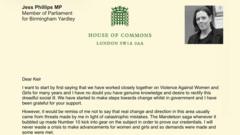
Phillips, a prominent voice within the Labour Party, confirmed her departure in a letter shared by the BBC, stating she could no longer support Starmer’s approach to governance. Other resigning ministers, whose names have not been disclosed, echoed similar sentiments in their letters, describing a fundamental disagreement over policy priorities and decision-making processes. The resignations were confirmed by a Downing Street spokesperson, who acknowledged the departures but declined to comment further.
Ministers cite policy and leadership concerns
The resignations follow months of speculation about internal divisions within the Labour government. Sources close to the ministers cited frustration over Starmer’s handling of key portfolios, including economic policy and social reforms. Phillips, known for her advocacy on domestic violence issues, reportedly objected to cuts in funding for victim support services, a cornerstone of her ministerial brief. The resignations suggest that early challenges may hinder Starmer’s ability to deliver on his legislative agenda.
The timing of the departures raises political risks for Starmer, who has sought to present a united front since taking office. The prime minister’s approval ratings remain mixed, with polls showing public skepticism about his government’s performance. Opposition parties have already seized on the resignations, with Conservative Party leader Rishi Sunak calling them a sign of ‘weakness and division’ within Labour. Political analysts warn that further resignations could erode public confidence in Starmer’s leadership.
Starmer faces pressure to maintain unity
Starmer is expected to address the resignations in a statement to Parliament Thursday, where he will likely emphasize his commitment to his agenda despite the setbacks. Government insiders suggest he may reshuffle his cabinet to fill the vacancies, though the loss of Phillips—a high-profile figure—represents a significant blow to his team. The prime minister has so far avoided public criticism of the departing ministers, focusing instead on his plans to address economic stagnation and public service reforms.
The resignations also highlight broader challenges facing Starmer’s government, including a narrow parliamentary majority and rising inflation. Critics argue that the departures signal deeper ideological splits within Labour, particularly over fiscal policy and social welfare spending. Meanwhile, supporters of Starmer insist the resignations are an isolated issue and do not reflect broader dissatisfaction with his leadership. The coming weeks will be critical in determining whether Starmer can regain momentum or if the departures foreshadow further instability.
What happens next remains unclear, but the resignations have already sparked a political firestorm. MPs from both sides of the aisle have called for greater transparency about the reasons behind the departures, while Labour backbenchers have privately expressed concern about the potential fallout. For Starmer, the challenge now is to demonstrate that he can govern effectively despite the internal strife, or risk undermining his authority at a pivotal moment in his premiership.
What You Need to Know
- Source: BBC News
- Published: May 12, 2026 at 16:59 UTC
- Category: Politics
- Topics: #bbc · #politics · #read · #ministers · #safeguarding-minister-jess
Read the Full Story
This is a curated summary. For the complete article, original data, quotes and full analysis:
All reporting rights belong to the respective author(s) at BBC News. GlobalBR News summarizes publicly available content to help readers discover the most relevant global news.
Curated by GlobalBR News · May 12, 2026
Related Articles
- Starmer’s leadership under pressure as Labour MPs question authority
- UK Labour’s Wes Streeting confirms leadership bid if race starts
🇧🇷 Resumo em Português
O primeiro-ministro britânico, Keir Starmer, enfrenta uma crise política sem precedentes após a renúncia em massa de ministros de alto escalão, incluindo a ministra da Segurança, Jess Phillips, que alegaram divergências profundas com seu estilo de liderança e políticas. A onda de desligamentos, a maior desde o início do governo Starmer, expõe fissuras no Partido Trabalhista e acende alertas sobre a estabilidade de sua gestão, em um momento crucial para o futuro do Reino Unido.
No Brasil, o episódio ganha relevo ao refletir os desafios comuns a governos recém-eleitos: a dificuldade de conciliar expectativas do eleitorado com as demandas de uma base política fragmentada. A saída de figuras centrais do governo britânico, como Phillips — conhecida por suas posições progressistas —, evidencia como a coesão partidária pode se tornar frágil diante de escolhas impopulares ou de mudanças bruscas de rumo. Para o Brasil, que vive sua própria dinâmica de polarização e realinhamentos políticos, o caso serve como um termômetro das tensões que podem surgir mesmo em governos que prometem unidade.
Com a pressão sobre Starmer aumentando, a próxima semana será decisiva: ou o premier britânico conseguirá reverter o desgaste interno, ou a instabilidade se alastrará, com potencial para abalar não só sua autoridade, mas também a credibilidade do Trabalhismo diante dos eleitores.
🇪🇸 Resumen en Español
La dimisión masiva de altos cargos en Reino Unido sacude el Gobierno de Keir Starmer, que enfrenta su mayor crisis de liderazgo apenas meses después de asumir el poder. La ministra de Protección Social, Jess Phillips, y otros miembros del gabinete abandonaron sus puestos en protesta por el estilo de gobierno y las decisiones políticas del primer ministro laborista, lo que amenaza con desestabilizar su ya frágil mayoría parlamentaria.
El malestar trasciende a figuras clave del partido y refleja tensiones internas por la deriva ideológica de Starmer, acusado de apartarse de las promesas progresistas para abrazar posturas más moderadas que alejan a la base tradicional laborista. La renuncia de Phillips, símbolo de la izquierda del partido, subraya el riesgo de fractura en un momento crítico para la gobernabilidad británica, mientras la oposición conservadora aprovecha para debilitar aún más al Gobierno. Para los lectores hispanohablantes, este episodio ilustra los desafíos de mantener la cohesión en coaliciones políticas y advierte sobre los costes de priorizar pragmatismo sobre convicción en tiempos de polarización.
BBC News
Read full article at BBC News →This post is a curated summary. All rights belong to the original author(s) and BBC News.
Was this article helpful?

Discussion