Navy photographer captures first public image of the U.S. military’s AIM-260 air-to-air missile during Florida test flight.
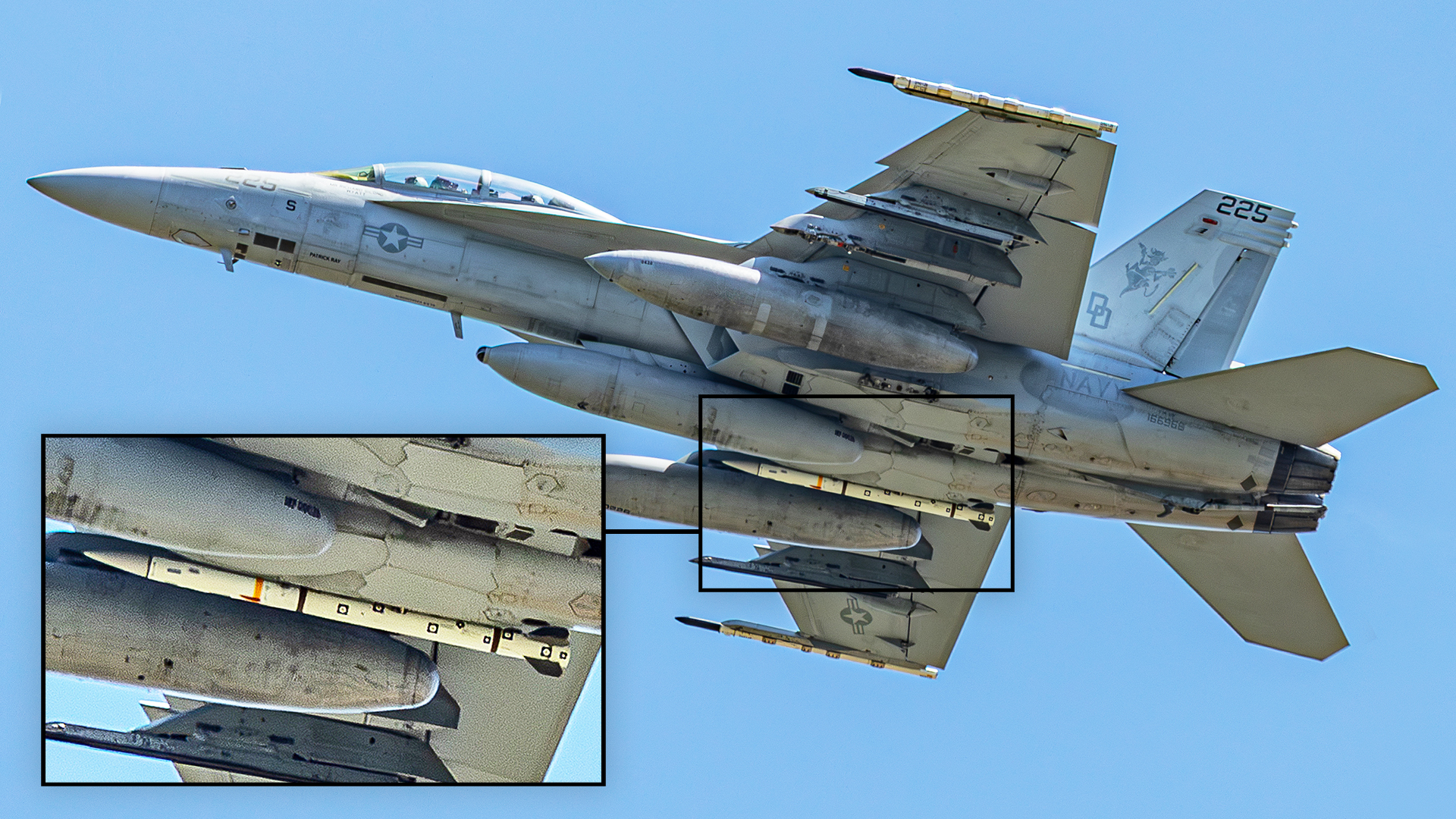
- Military releases first public image of AIM-260 JATM after years of flight testing
- F/A-18F Super Hornet from VX-31 carried missile during May 13 test flight
- AIM-260 expected to replace AIM-120 AMRAAM in U.S. service
The U.S. Air Force has released the first public image of its AIM-260 Joint Advanced Tactical Missile (JATM), ending years of secrecy around the next-generation air-to-air weapon. The missile was photographed attached to an F/A-18F Super Hornet from Air Test and Evaluation Squadron 31 (VX-31), which departed Eglin Air Force Base in Florida on May 13 during a test sortie. The jet carried the AIM-260 on its fuselage station, outboard of the right engine intake, marking the first time the weapon has been seen outside classified testing environments.
Development history and role
The AIM-260 JATM is being developed as a direct successor to the AIM-120 Advanced Medium-Range Air-to-Air Missile (AMRAAM), which has been the U.S. military’s primary beyond-visual-range air-to-air weapon since the 1990s. While the AMRAAM remains in service and continues to be upgraded, the AIM-260 is designed to offer extended range, improved guidance, and greater lethality against advanced threats such as stealth aircraft and hypersonic missiles. The missile’s existence was first acknowledged in 2019, but details about its performance and deployment timeline have remained closely guarded.
Photographer Jonathan Tweedy captured the images during a routine test flight, revealing not only the AIM-260 but also a modified FPU-13/A drop tank fitted with an infrared search and track (ISRT) sensor on the aircraft’s centerline station. The ISRT pod is part of ongoing upgrades to the Super Hornet’s sensor suite, enabling passive detection of airborne targets without emitting radar signals that could alert adversaries. This configuration suggests the AIM-260 is being tested in an operational context, integrating with existing aircraft systems before full-scale deployment.
Technical specifications and testing
While the U.S. Air Force has not released detailed specifications for the AIM-260, reports from defense analysts and previous disclosures indicate the missile is designed to exceed the AMRAAM’s range of approximately 100 miles. The AIM-260 is believed to leverage advanced propulsion, guidance, and seeker technologies, including a two-way data link for networked combat operations. Its development is being led by Lockheed Martin Lockheed Martin, which also produces the AMRAAM, under the oversight of the Air Force’s Life Cycle Management Center.
Flight testing of the AIM-260 began several years ago, with incremental progress toward operational readiness. The May 13 sortie, documented by Tweedy, provides the first visual confirmation of the missile’s integration with a frontline aircraft, specifically the F/A-18F Super Hornet. This aircraft, flown by VX-31, is a dedicated test and evaluation unit based at Naval Air Station China Lake in California but was operating from Eglin for the test. The presence of the ISRT pod further indicates that the trials are evaluating not just the missile’s performance but also its compatibility with modern sensor suites.
Strategic implications for air combat
The introduction of the AIM-260 is expected to significantly alter the dynamics of air-to-air combat, particularly in contested environments where stealth and electronic warfare play critical roles. The missile’s extended range would allow U.S. and allied aircraft to engage targets from safer distances, reducing exposure to enemy air defenses. Its improved guidance systems, potentially including a multi-mode seeker, would enhance its ability to track and intercept maneuvering or low-observable targets.
Military officials have not specified when the AIM-260 will enter full operational service, but its development timeline suggests initial deployments could occur in the mid-2020s. The missile is also expected to be integrated into the F-35 Lightning II F-35 Lightning II, which is already slated to carry the AMRAAM. This cross-platform compatibility will ensure the AIM-260 can be fielded rapidly across multiple fighter fleets, providing a common air-to-air capability for the U.S. and its allies.
Broader defense context
The AIM-260’s emergence comes amid a global race to develop next-generation air-to-air missiles, with China and Russia also fielding advanced systems such as the PL-15 and RVV-SD. The U.S. military’s push to field the AIM-260 underscores its commitment to maintaining air superiority in an era of rapidly evolving threats. The missile’s development aligns with broader efforts to modernize the U.S. fighter fleet, including upgrades to the F-22 Raptor and F-15EX Eagle II, which will also carry the new weapon.
While the AIM-260’s exact capabilities remain classified, its introduction signals a shift toward more sophisticated and longer-range air combat solutions. The missile’s integration with existing platforms like the Super Hornet and future fighters such as the Next Generation Air Dominance (NGAD) aircraft will ensure its relevance for decades to come. For now, the public glimpse of the AIM-260 offers the first tangible evidence of the U.S. military’s next leap in air-to-air lethality.
What You Need to Know
- Source: The Drive
- Published: May 15, 2026 at 17:39 UTC
- Category: War
- Topics: #military · #weapons · #conflict · #war · #defense · #secretive
Read the Full Story
This is a curated summary. For the complete article, original data, quotes and full analysis:
All reporting rights belong to the respective author(s) at The Drive. GlobalBR News summarizes publicly available content to help readers discover the most relevant global news.
Curated by GlobalBR News · May 15, 2026
🇧🇷 Resumo em Português
A imagem inédita de um dos armamentos mais sigilosos dos Estados Unidos, o míssil ar-ar AIM-260, foi revelada ao público, marcando um salto tecnológico que pode redefinir o equilíbrio de poder nos céus globais. O míssil, desenvolvido pela Lockheed Martin, promete superar em alcance, velocidade e precisão seu predecessor, o AIM-120 AMRAAM, em operação há mais de três décadas, e já foi submetido a testes de voo há anos. A fotografia, ainda que borrada e sem detalhes sensíveis, lança luz sobre um programa que até então circulava apenas em especulações entre analistas de defesa e rivais geopolíticos.
O lançamento do AIM-260 não é apenas uma atualização tecnológica, mas um movimento estratégico que coloca o Brasil e outros países de língua portuguesa em uma encruzilhada. Com a capacidade de engajar alvos a distâncias superiores a 200 quilômetros — quase o dobro do AMRAAM — e possivelmente operar em ambientes de guerra eletrônica cada vez mais complexos, o míssil reforça a superioridade aérea dos EUA em um momento de tensões crescentes com potências como China e Rússia. Para o Brasil, que busca modernizar sua frota de caças com aquisições como os F-35 e a possível parceria para desenvolver o Gripen E, a chegada do AIM-260 pode influenciar não apenas escolhas de armamentos, mas também alianças regionais e a dissuasão de ameaças no Atlântico Sul.
A revelação pública do míssil deve acelerar demandas por respostas tecnológicas por parte de outros atores globais, enquanto os próximos testes e integrações com plataformas como o F-22 e o F-35 serão acompanhados de perto por estrategistas brasileiros e latino-americanos.
🇪🇸 Resumen en Español
Por primera vez, el mundo ha visto imágenes del AIM-260, el nuevo misil aire-aire secreto de Estados Unidos, diseñado para revolucionar la capacidad de combate aéreo de Washington.
El AIM-260, desarrollado por Lockheed Martin en secreto durante años, promete superar al AIM-120 AMRAAM, el misil de medio alcance más utilizado en la OTAN. Con mayor alcance y precisión, este avance tecnológico refuerza la supremacía aérea estadounidense frente a potencias como China y Rusia, que ya han desarrollado sistemas similares. Para España y sus socios europeos, la aparición de este misil subraya la urgencia de modernizar sus arsenales o quedar relegados en el equilibrio estratégico global. Además, su despliegue podría alterar las dinámicas de tensión en regiones como el Indo-Pacífico, donde las capacidades de defensa son clave.
The Drive
Read full article at The Drive →This post is a curated summary. All rights belong to the original author(s) and The Drive.
Was this article helpful?


Discussion