Ebola outbreak in eastern DR Congo kills 80, infects 246, reaching Uganda.
- Health officials confirm 246 Ebola cases in eastern DR Congo
- Death toll from outbreak rises to 80
- Uganda reports its first case linked to DR Congo outbreak
An Ebola virus outbreak in eastern Democratic Republic of Congo has killed 80 people and sickened at least 246 since the surge began, the Africa Centres for Disease Control and Prevention (Africa CDC) reported Tuesday. The outbreak, which emerged in the volatile North Kivu and Ituri provinces, marks the latest in a series of deadly resurgences in the region since 2018.
Health authorities confirmed the first cross-border case on Tuesday after a patient from DR Congo traveled to southwestern Uganda and tested positive for Ebola. The patient, who was asymptomatic upon arrival, developed symptoms and was isolated in Uganda’s Mpondwe health facility. Uganda’s Ministry of Health has activated rapid response teams and contact tracing to prevent further spread.
The Africa CDC, the continent’s top health agency, said case counts continue to rise despite containment efforts. Of the 246 reported cases, 161 have been confirmed, 51 are probable, and 34 remain suspected. The death toll includes patients from both Congo and Uganda. The agency warned that the porous borders and ongoing conflict in eastern Congo could complicate containment.
WHO and local teams ramp up response
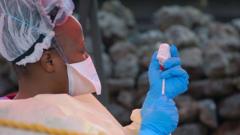
Local health teams, supported by the World Health Organization (WHO), are conducting mass vaccination campaigns using the approved Ervebo vaccine. More than 20,000 doses have been administered so far, targeting high-risk groups in border areas. Health workers are also distributing protective equipment and setting up isolation centers in affected towns.
DR Congo’s government declared a new health emergency last week, authorizing the use of experimental treatments and expanding surveillance. The WHO has dispatched additional experts to support the response, but logistical challenges persist due to insecurity and limited access to remote areas.
Uganda prepares for worst-case scenario
Uganda activated its national Ebola preparedness plan after confirming its first case linked to the DR Congo outbreak. Health Minister Jane Ruth Aceng said all points of entry along the Congo border are under heightened surveillance, with thermal scanners and health screening in place. Schools in affected districts have been advised to reinforce hygiene practices.
Across the border, DR Congo’s health ministry reported that the outbreak originated near the city of Beni, a hotspot for previous Ebola flare-ups. Genetic sequencing shows the current strain matches earlier outbreaks in the region, suggesting it may have persisted in animal reservoirs or survivors.
Lessons from past outbreaks offer hope and challenges
This is the 14th Ebola outbreak in DR Congo since 1976, with the deadliest occurring between 2018 and 2020, killing over 2,200 people. The current surge comes as health systems in eastern Congo remain weakened by years of conflict, displacement, and distrust in authorities.
Experts warn that without sustained funding and community engagement, the outbreak could spiral. Neighboring countries, including Rwanda and Burundi, have increased border monitoring, while the Africa CDC has called for $20 million in emergency funding to support the response through June.
The next two weeks will be critical as health teams race to contain the spread before it reaches densely populated areas. With vaccines and treatments available, the focus now is on preventing further cross-border transmission and reaching remote communities before the virus gains a foothold.
What You Need to Know
- Source: BBC News
- Published: May 16, 2026 at 04:11 UTC
- Category: World
- Topics: #bbc · #world-news · #international · #ebola · #congo-africa · #uganda
Read the Full Story
This is a curated summary. For the complete article, original data, quotes and full analysis:
All reporting rights belong to the respective author(s) at BBC News. GlobalBR News summarizes publicly available content to help readers discover the most relevant global news.
Curated by GlobalBR News · May 16, 2026
Related Articles
- Eurovision 2024 faces scrutiny over Israel’s participation amid war
- US Justice Department preparing indictment against Raúl Castro
- US planning to criminally indict ex-Cuban leader Raúl Castro
🇧🇷 Resumo em Português
O surto de Ebola no leste da República Democrática do Congo (RDC) já ceifou 80 vidas e registrou 246 casos, segundo dados da África CDC, com um caso até mesmo cruzando a fronteira para Uganda, acendendo alertas globais. A epidemia, que persiste há meses na região instável de Kivu do Norte, reacende o temor de uma crise sanitária de proporções continentais, especialmente após a confirmação de transmissão transfronteiriça, um cenário que lembra tragédias passadas como a epidemia de 2014-2016 na África Ocidental. Para o Brasil, que mantém laços de cooperação sanitária com a África por meio da Fiocruz e da OPAS, a situação serve como um lembrete da vulnerabilidade compartilhada diante de doenças negligenciadas, apesar da distância geográfica.
O contexto é ainda mais preocupante devido à complexidade da região: conflitos armados, deslocamentos populacionais e desconfiança das comunidades locais em relação às autoridades dificultam o controle da doença. A Organização Mundial da Saúde (OMS) já havia classificado o surto como uma “emergência de saúde pública de importância internacional” em 2019, mas a falta de recursos e a recorrência de casos mostram que as medidas preventivas ainda são insuficientes. Para o público lusófono, especialmente em países como Angola e Moçambique, onde sistemas de saúde enfrentam desafios semelhantes, a situação reforça a necessidade de vigilância constante e investimentos em vigilância epidemiológica.
A expectativa agora é de uma resposta coordenada entre governos africanos, agências internacionais e doadores para evitar que o surto se espalhe, enquanto a vigilância brasileira reforça os protocolos de fronteira para detectar possíveis casos suspeitos.
🇪🇸 Resumen en Español
El brote de ébola en el este de la República Democrática del Congo ya ha dejado 80 muertos y 246 casos confirmados, extendiendo su sombra más allá de las fronteras con un primer contagio detectado en Uganda. La emergencia sanitaria, que se prolonga desde hace más de un año, vuelve a encender las alarmas en una región donde la inestabilidad crónica y la desconfianza de la población complican la contención de la enfermedad.
Esta epidemia, una de las más graves registradas en el país, refleja la vulnerabilidad de África Central ante crisis sanitarias que se entrelazan con conflictos armados, pobreza y sistemas de salud frágiles. Para los hispanohablantes, el riesgo de propagación internacional —aunque mínimo— recuerda a brotes pasados como el de 2014, cuando el ébola traspasó el Atlántico. La respuesta coordinada entre organizaciones como la OMS y el Centro Africano para el Control y Prevención de Enfermedades (CDC África) será clave, pero la desinformación y el rechazo a las vacunas en comunidades locales siguen siendo obstáculos formidables.
BBC News
Read full article at BBC News →This post is a curated summary. All rights belong to the original author(s) and BBC News.
Was this article helpful?

Discussion