Dead sperm whale found near Danish island after failed German rescue attempt.
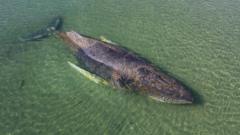
- German rescuers attempted to free trapped sperm whale
- Critics warned rescue would harm the animal
- Dead whale later found near Danish island of Bornholm
A sperm whale was found dead near Bornholm, Denmark, on Friday, days after German rescuers attempted to free it from shallow waters off Rügen island. The animal, later identified as a 14-meter male sperm whale, had become stranded multiple times in recent weeks, prompting local authorities to call for assistance. Rescue teams from Germany and Denmark worked for days to guide the whale back to deeper waters, but the animal repeatedly returned to the shallows before finally succumbing.
Environmental groups warned rescue would fail
Wildlife experts had criticized the rescue operation before it began, arguing that the whale was already severely stressed and that further interference could worsen its condition. ‘Sperm whales are deep-diving species,’ said Jonas Teilmann, a marine biologist at Aarhus University. ‘Stranding events like this often end tragically, and human intervention can exacerbate the situation.’ Danish and German authorities defended the attempt, stating they acted to prevent the whale’s suffering in shallow waters where it risked dehydration or injury from boats.
The whale was first spotted in German waters near Rügen in mid-July, where it repeatedly became stuck in sandbanks. Rescuers used boats to guide it into deeper channels, but the animal kept returning to the same area. On July 28, the whale was seen swimming erratically near Denmark’s Bornholm island, where it eventually died. Danish authorities reported the whale was in poor condition when found, with signs of exhaustion and possible internal injuries.
Investigations underway to determine cause of death
Danish and German officials have launched joint investigations into the whale’s death, including necropsies to determine the exact cause. Initial reports suggest the animal suffered from prolonged stress and physical strain from repeated attempts to free it. ‘The whale’s body showed signs of severe dehydration and muscle damage,’ said a spokesperson for the Danish Nature Agency. ‘While we regret the outcome, the rescue was an attempt to alleviate immediate suffering.’
The incident has reignited debates about how to handle stranded marine mammals. Some conservationists argue that natural processes should be allowed to take their course in such cases to avoid further harm, while others believe human intervention is justified to prevent prolonged suffering. The dead whale’s carcass will be studied to contribute to ongoing research on sperm whale strandings in the Baltic Sea region.
Marine biologists warn that climate change and human activity, such as increased shipping and underwater noise, may contribute to higher rates of whale strandings in the future. The Baltic Sea’s shallow waters and busy shipping lanes already pose risks to large marine animals. Authorities in both Germany and Denmark are reviewing protocols for handling future strandings to balance animal welfare with human safety.
Rescuers expressed sadness over the outcome but noted that the operation provided valuable data for future efforts. ‘Even failed rescues teach us how to better respond next time,’ said a German coast guard official. ‘We will use this experience to improve our strategies for protecting marine life.’
What You Need to Know
- Source: BBC News
- Published: May 16, 2026 at 17:01 UTC
- Category: World
- Topics: #bbc · #world-news · #international · #whale · #danish · #german
Read the Full Story
This is a curated summary. For the complete article, original data, quotes and full analysis:
All reporting rights belong to the respective author(s) at BBC News. GlobalBR News summarizes publicly available content to help readers discover the most relevant global news.
Curated by GlobalBR News · May 16, 2026
Related Articles
- Zimbabwe’s diaspora reshapes real estate and farming investment trends
- 🎉 250 Articles in World!
- Eurovision 2024 faces scrutiny over Israel’s participation amid war
🇧🇷 Resumo em Português
Um espetáculo trágico e evitável tomou conta das águas geladas do Mar do Norte: uma baleia morta foi avistada perto de uma ilha dinamarquesa, dias após uma equipe alemã tentar, sem sucesso, resgatá-la de uma rede de pesca onde ficou presa. O animal, que teria sofrido graves lesões durante a tentativa de libertação, virou mais um triste exemplo dos perigos que a vida marinha enfrenta diariamente por causa da interferência humana.
A cena, que chocou ambientalistas e moradores locais, não é um caso isolado no cenário global, mas ganha contornos especialmente preocupantes para o Brasil, país que abriga uma das maiores biodiversidades marinhas do mundo e extensas rotas de navegação e pesca. A morte da baleia na Dinamarca evidencia a urgência de discutir, também em terras brasileiras, medidas mais rigorosas contra a pesca predatória, o emaranhamento em redes industriais e a falta de protocolos eficientes de resgate para grandes cetáceos — desafios que já se repetem em nossas costas, como no litoral do Rio de Janeiro e do Rio Grande do Sul.
O episódio deve servir como alerta não só para autoridades europeias, mas também para o Brasil e outros países lusófonos, que precisam reforçar a fiscalização e investir em tecnologias de monitoramento para evitar que cenas como essa se tornem rotina.
🇪🇸 Resumen en Español
Una ballena muerta apareció flotando cerca de las costas de Dinamarca tras el fallido intento de rescate por parte de un equipo alemán, que había alertado sobre los graves riesgos que enfrentaba el animal. La escena ha reavivido el debate sobre la protección de especies marinas en aguas europeas, donde los varamientos y la intervención humana siguen siendo un problema recurrente.
El incidente, ocurrido en aguas del mar del Norte, refleja los desafíos logísticos y éticos que enfrentan las autoridades cuando intentan salvar cetáceos en peligro. Para los hispanohablantes, este caso recuerda la importancia de iniciativas como las redes de avistamiento temprano y los protocolos de actuación coordinados entre países, especialmente en una región donde el tráfico marítimo y la contaminación amenazan cada vez más a la fauna. Además, subraya la necesidad de reforzar las políticas ambientales en la Unión Europea, donde los avances en conservación contrastan con los casos de malas prácticas que terminan en tragedias evitables.
BBC News
Read full article at BBC News →This post is a curated summary. All rights belong to the original author(s) and BBC News.
Was this article helpful?


Discussion