Trump faces MAGA backlash as China policy softens before Beijing trip.
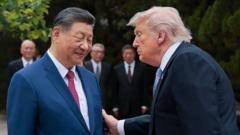
- Trump softens China stance ahead of Beijing visit
- MAGA critics split over policy shift
- Experts say change may influence Republican base
Donald Trump’s upcoming trip to Beijing is raising questions about his evolving stance on China, a shift that critics in the MAGA movement are struggling to reconcile. The former president, who previously framed China as an economic and military threat, has recently softened his rhetoric, signaling a possible move toward engagement rather than confrontation. Analysts say this adjustment could influence how his loyal base views U.S.-China relations moving forward.
Trump’s evolving China policy
Trump’s relationship with China has shifted significantly since his first term, when he imposed tariffs and accused Beijing of unfair trade practices. During his 2016 campaign and early presidency, he frequently criticized China’s economic policies, labeling the country a strategic competitor. However, in recent months, Trump has suggested a more cooperative approach, emphasizing dialogue and potential trade deals rather than aggressive confrontation.
This change has not gone unnoticed by his critics within the MAGA movement, who once rallied behind his hardline stance. Some supporters now question whether Trump’s softer tone reflects a pragmatic shift or a departure from the policies that defined his first term. Political analysts argue that his evolving approach could signal a broader realignment in Republican Party strategy on China.
MAGA critics react to Trump’s softening stance
Supporters who once praised Trump’s tough-on-China rhetoric are now divided over his latest moves. Some hardline conservatives argue that his softer stance undermines the economic and security policies that resonated with voters in 2016 and 2020. Others, however, see it as a necessary adjustment in a shifting global landscape where cooperation may be more effective than confrontation.
The debate highlights a growing tension within the MAGA movement, where loyalty to Trump’s leadership often clashes with policy preferences. While some critics remain vocal about their concerns, others are willing to accept the shift if it leads to tangible benefits for American workers and businesses. The division underscores the complexity of Trump’s influence over his political base.
Experts weigh in on Trump’s strategy
Foreign policy analysts suggest that Trump’s softer approach may be an attempt to balance economic interests with national security concerns. His recent comments about China have focused on trade imbalances and job losses, rather than the military threats that dominated his earlier rhetoric. Some experts believe this shift could pave the way for new negotiations, while others warn that it risks emboldening Beijing without securing meaningful concessions.
The Biden administration’s approach to China has also played a role in Trump’s evolving strategy. While the current White House maintains a tough stance on trade and technology restrictions, Trump has sought to differentiate himself by proposing alternative solutions. His recent overtures to Chinese officials suggest a willingness to explore new avenues of cooperation, even as broader tensions persist.
In the coming weeks, Trump’s Beijing trip will serve as a test of his ability to navigate these competing interests. If he returns with tangible agreements—such as trade deals or security commitments—his critics may be forced to reconsider their objections. However, if the visit yields little progress, the backlash within the MAGA movement could intensify, further straining the coalition that helped propel him to power.
What You Need to Know
- Source: BBC News
- Published: May 15, 2026 at 19:52 UTC
- Category: World
- Topics: #bbc · #world-news · #international · #war · #conflict · #maga
Read the Full Story
This is a curated summary. For the complete article, original data, quotes and full analysis:
All reporting rights belong to the respective author(s) at BBC News. GlobalBR News summarizes publicly available content to help readers discover the most relevant global news.
Curated by GlobalBR News · May 15, 2026
Related Articles
- US proposes 40% cut in Colorado River water for 3 states amid drought
- Trump urges Taiwan to avoid independence amid rising China tensions
- Xi gives Trump private tour of secret garden in Beijing
🇧🇷 Resumo em Português
O ex-presidente norte-americano Donald Trump surpreendeu aliados e críticos ao suavizar seu tom em relação à China, dias antes de uma viagem oficial a Pequim, reacendendo uma divisão no coração do movimento MAGA. Enquanto tradicionalmente defendeu uma postura dura contra o regime chinês, Trump agora sinaliza uma abordagem mais pragmática, o que já começa a gerar desconfiança entre seus fiéis seguidores, acostumados a retóricas de confronto comercial e geopolítico.
A mudança de postura de Trump ocorre em um momento crucial para as relações sino-americanas, com impactos diretos no Brasil, especialmente em setores como agronegócio e indústria, que dependem do mercado chinês. Para o eleitorado brasileiro, a notícia ganha relevância ao evidenciar como as decisões de Washington influenciam cadeias globais de suprimentos e preços de commodities. Especialistas ouvidos pela imprensa destacam que, se consolidada, essa nova estratégia poderia redefinir alianças comerciais e até aliviar pressões tarifárias sobre produtos brasileiros que competem com a China no mercado internacional.
Ainda não está claro se a guinada de Trump é uma manobra tática para garantir concessões em Pequim ou um sinal de realinhamento estratégico, mas uma coisa é certa: a viagem à capital chinesa promete reacender debates sobre a política externa dos EUA e suas consequências para a América Latina.
🇪🇸 Resumen en Español
El expresidente estadounidense Donald Trump ha sorprendido a sus seguidores más radicales al suavizar su retórica contra China en vísperas de un viaje a Pekín, desatando un cisma en el seno del movimiento MAGA.
Este cambio de tono, que incluye un posible alivio de los aranceles y un enfoque más colaborativo en temas globales, refleja la complejidad de la política exterior actual. Para los hispanohablantes, especialmente aquellos vinculados a la economía o al comercio internacional, esta evolución podría tener repercusión en los mercados y en las relaciones comerciales entre EE.UU. y Asia, donde Latinoamérica tiene intereses estratégicos. Además, la división en el campo republicano subraya los desafíos de mantener una línea dura sin afectar la estabilidad económica, un debate que trasciende fronteras y afecta a millones de personas.
BBC News
Read full article at BBC News →This post is a curated summary. All rights belong to the original author(s) and BBC News.
Was this article helpful?


Discussion