Astrophotographer photographs Markarian’s Chain, a stunning string of galaxies, using a backyard telescope.
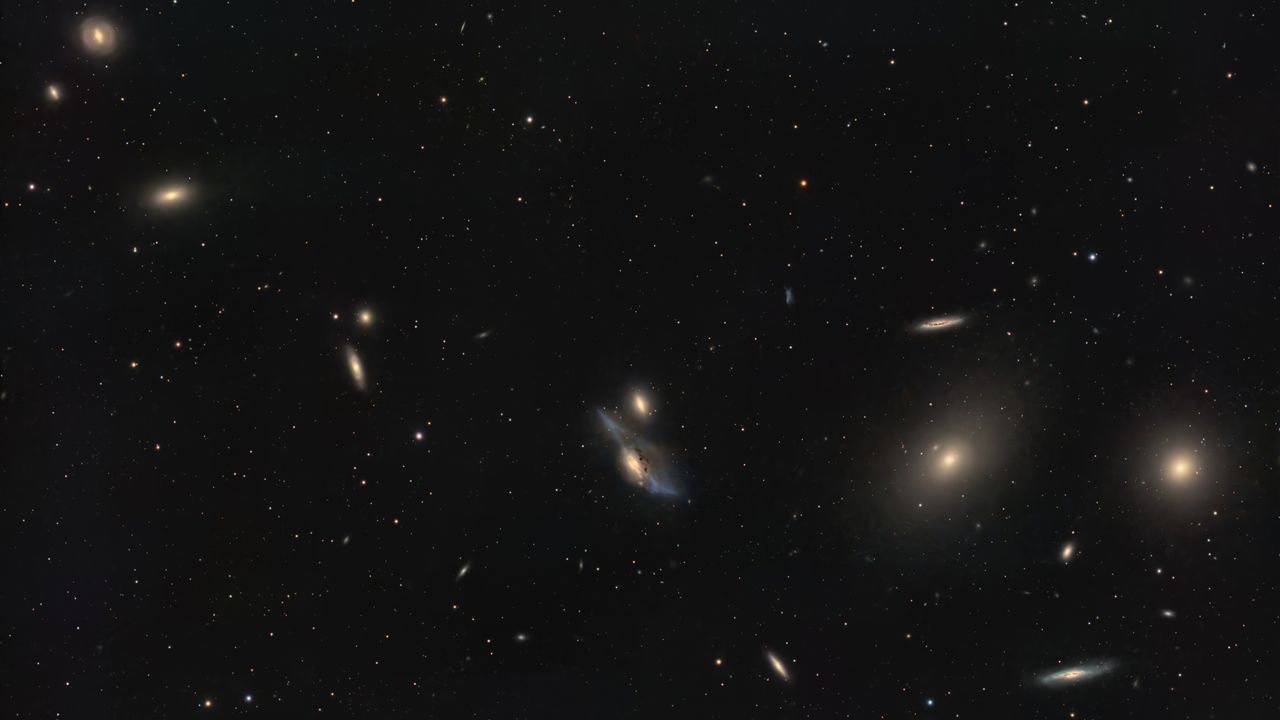
- Image shows 8 bright galaxies aligned in a cosmic chain
- Markarian’s Chain spans constellations Leo, Virgo, and Coma Berenices
- Amateur setup captured the galaxies with 10-hour exposure in backyard
An astrophotographer has captured a remarkable deep-space image of Markarian’s Chain, a striking alignment of galaxies visible through amateur telescopes. The photo, taken from a backyard setup, shows eight bright galaxies strung together in a visually stunning cosmic chain spanning the constellations Leo, Virgo, and Coma Berenices. This celestial feature is one of the most photographed deep-sky objects by backyard astronomers due to its accessibility and beauty.
How to find Markarian’s Chain in the night sky
Markarian’s Chain is part of the Virgo Cluster, a massive grouping of galaxies located 50 to 60 million light-years from Earth. To locate it, stargazers should first find the bright star Denebola in Leo, then scan eastward toward the constellation Virgo. The chain appears as a faint, curved line of smudges in the sky, best observed under dark conditions away from city lights. Spring months offer the clearest views for Northern Hemisphere observers.
The science behind the galactic chain
Markarian’s Chain is named after Soviet astrophysicist Benjamin Markarian, who studied the galaxies in the 1960s and discovered their unusual motion. The chain includes several massive elliptical galaxies, including M84, M86, and NGC 4438, which are gravitationally bound in a slow, orbital dance. These galaxies host billions of stars each, with some containing supermassive black holes at their centers that influence their motion.
Tools for photographing deep-space objects
Capturing images like this requires patience and the right equipment. Most amateur astrophotographers use telescopes with focal lengths between 400mm and 1000mm, paired with cooled CCD or CMOS cameras capable of long exposures. The photographer who took this image used a 10-hour total exposure time to reveal faint details in the galaxies. Light pollution filters and tracking mounts are essential to counteract Earth’s rotation and improve image sharpness.
Why Markarian’s Chain fascinates astronomers
The chain’s unique structure provides clues about the dynamics of galaxy clusters. Some galaxies in the chain, like NGC 4435 and NGC 4438, show signs of past interactions, with distorted shapes and streams of gas between them. Studying these interactions helps scientists understand how galaxies evolve over billions of years. For amateur astronomers, Markarian’s Chain offers a glimpse into the sheer scale and beauty of the universe from their own backyards.
The next step for many stargazers is to observe or photograph Markarian’s Chain themselves. Local astronomy clubs often host public viewing nights where beginners can try spotting the chain with guidance. As technology improves, even more detailed images of this celestial wonder are expected from amateur astronomers worldwide.
What You Need to Know
- Source: Space.com
- Published: May 13, 2026 at 18:00 UTC
- Category: Science
- Topics: #space · #astronomy · #nasa · #science · #astrophotographer · #markarian’s-chain
Read the Full Story
This is a curated summary. For the complete article, original data, quotes and full analysis:
All reporting rights belong to the respective author(s) at Space.com. GlobalBR News summarizes publicly available content to help readers discover the most relevant global news.
Curated by GlobalBR News · May 13, 2026
🇧🇷 Resumo em Português
Com um equipamento modesto, mas muita paciência, um astrofotógrafo brasileiro conseguiu registrar um fenômeno cósmico que parece tirado de um conto de ficção científica: o par de galáxias conhecido como “Olhos”, parte da cadeia de Markarian, entre as constelações de Leão e Virgem.
A imagem, capturada com um telescópio de quintal, revela dois pontos luminosos que se destacam no vasto escuro do espaço, como se fossem os olhos de um gigante adormecido. Essa região do céu é famosa entre astrônomos amadores e profissionais por abrigar aglomerados de galáxias que desafiam a imaginação, mas raras vezes são registradas com tanta clareza por equipamentos caseiros. Para o Brasil, onde a astronomia amadora tem crescido com clubes e iniciativas de popularização da ciência, essa façanha reforça que grandes descobertas podem começar no fundo do quintal, mesmo em um país de dimensões continentais e céus nem sempre livres de poluição luminosa. Além disso, a façanha inspira outros entusiastas a mirar seus telescópios para além da Lua e dos planetas, explorando as profundezas do universo visível.
Agora, a comunidade científica e os apaixonados pelo céu noturno aguardam por mais registros como esse, que podem ajudar a mapear estruturas cósmicas ainda pouco estudadas e, quem sabe, revelar segredos escondidos entre as estrelas.
🇪🇸 Resumen en Español
Un aficionado a la astronomía ha logrado capturar con un telescopio doméstico una imagen excepcional de las galaxias del “Cadenón de Markarian”, un espectacular conjunto estelar entre las constelaciones de Leo y Virgo. La instantánea, que muestra dos galaxias elípticas brillantes rodeadas de otras menores, ha dejado boquiabiertos incluso a los expertos por su nitidez y profundidad.
Este hallazgo no solo demuestra el potencial de la astronomía amateur —que con equipos accesibles puede obtener resultados profesionales—, sino que invita a millones de hispanohablantes a explorar el cosmos desde sus propios hogares. Markarian’s Chain, parte del cúmulo de Virgo, es un objeto de estudio clave para entender la evolución galáctica, y su observación con telescopios modestos abre una ventana accesible al fascinante mundo de la astrofísica.
Space.com
Read full article at Space.com →This post is a curated summary. All rights belong to the original author(s) and Space.com.
Was this article helpful?

Discussion