US and Nigerian troops kill Islamic State’s second-in-command in Nigeria.

- US and Nigerian forces kill Islamic State’s second-in-command in Nigeria
- Operation conducted in Nigeria’s northwest region
- ISIS militant described as 'most active terrorist in the world'
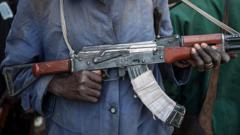
A senior Islamic State group leader, identified as the militant organization’s second-in-command, was killed in a joint U.S.-Nigerian military operation in northwest Nigeria, the countries’ presidents confirmed Tuesday. The operation targeted a high-value target in the region, where Islamic State’s affiliate has been active in recent years. Nigerian President Bola Tinubu and U.S. President Joe Biden separately announced the killing, which marks a significant blow to the group’s leadership in Africa. The militant, whose name was not immediately disclosed, was described by officials as the ‘most active terrorist in the world’ due to his role in directing attacks across multiple countries. Intelligence sources suggest he played a key role in planning and financing operations for the Islamic State’s West Africa Province, a faction responsible for numerous deadly assaults in the region. The operation follows months of surveillance and coordination between U.S. and Nigerian forces, including intelligence-sharing and logistical support from U.S. Africa Command. ## Joint operation details Nigerian troops, backed by U.S. intelligence and air support, carried out the operation in a remote area near the border with Niger, officials said. The militant was killed during a firefight after refusing to surrender, according to a statement from Nigeria’s defense ministry. No civilians were reported injured in the operation, which was conducted under strict rules of engagement to minimize collateral damage. U.S. officials confirmed the use of precision airstrikes to neutralize the target, avoiding civilian casualties. The militant’s death comes as Islamic State’s West Africa Province has intensified attacks in Nigeria, Burkina Faso, and Niger, despite recent military pressure from regional forces. ## Broader implications of the killing The killing of the Islamic State’s second-in-command in Nigeria is expected to disrupt the group’s operations in West Africa, where it has exploited instability and weak governance to expand its influence. Analysts warn, however, that the militant’s death may not immediately end the violence, as the group has a history of quickly replacing leadership to maintain its operations. The operation underscores the ongoing counterterrorism cooperation between the U.S. and African nations, particularly in regions where Islamic State affiliates have gained a foothold. Nigerian authorities have vowed to continue targeting high-level operatives, while the U.S. has reaffirmed its commitment to supporting regional allies in the fight against extremist groups. The Islamic State’s West Africa Province, once aligned with Nigeria’s Boko Haram, has emerged as one of the group’s most active affiliates, responsible for thousands of deaths in the past decade. While the militant’s death is a setback, security experts caution that the broader threat from Islamic State remains, with sleeper cells and recruitment efforts continuing in remote areas. For now, the focus shifts to assessing the impact on the group’s command structure and whether the killing will lead to further disruptions in its operations.
What You Need to Know
- Source: France 24
- Published: May 16, 2026 at 14:25 UTC
- Category: World
- Topics: #france24 · #world-news · #europe · #politics · #government · #nigeria
Read the Full Story
This is a curated summary. For the complete article, original data, quotes and full analysis:
All reporting rights belong to the respective author(s) at France 24. GlobalBR News summarizes publicly available content to help readers discover the most relevant global news.
Curated by GlobalBR News · May 16, 2026
Related Articles
- Zimbabwe’s diaspora reshapes real estate and farming investment trends
- 🎉 250 Articles in World!
- Eurovision 2024 faces scrutiny over Israel’s participation amid war
🇧🇷 Resumo em Português
Em uma operação conjunta histórica, os Estados Unidos e a Nigéria eliminaram o segundo comandante do Estado Islâmico na África Ocidental, um golpe significativo contra a organização terrorista que expande sua influência no continente. O anúncio, feito pelos presidentes dos dois países, marca mais um capítulo na luta contra grupos extremistas que ameaçam não só a segurança regional, mas também a estabilidade global.
A morte do líder terrorista, confirmada por fontes oficiais dos EUA e da Nigéria, representa um duro revés para o braço africano do Estado Islâmico, responsável por ataques brutais e recrutamento de combatentes na região. Para o Brasil, que mantém relações estratégicas com a Nigéria e outros países africanos, a operação reforça a importância da cooperação internacional no combate ao terrorismo, um tema que ganha cada vez mais relevância diante do crescente fluxo migratório e da diáspora africana no país. Além disso, a notícia chega em um momento em que o governo brasileiro discute políticas de segurança e prevenção à radicalização, especialmente após casos recentes de brasileiros envolvidos em grupos extremistas no exterior.
Agora, o foco deve se voltar para o destino do grupo e possíveis ações de retaliação, enquanto os governos dos EUA e da Nigéria avaliam os próximos passos para consolidar a vitória estratégica contra o terrorismo na região.
🇪🇸 Resumen en Español
Las fuerzas conjuntas de Estados Unidos y Nigeria han eliminado al segundo al mando del Estado Islámico en África Occidental, un golpe estratégico contra la red yihadista que sacude los cimientos de su influencia en la región. La operación, confirmada por los presidentes de ambos países, marca un hito en la lucha antiterrorista y reaviva el debate sobre la eficacia de las alianzas militares internacionales en el Sahel.
El fallecido, identificado como Abu Musab al-Barnawi, era una figura clave en la expansión del grupo bajo la égida de la franquicia Province of West Africa (ISWAP), vinculada al autodenominado Estado Islámico. Su muerte no solo debilita la cadena de mando yihadista, sino que también envía un mensaje de contundencia a las facciones restantes, que han multiplicado sus ataques en Nigeria y países vecinos como Chad y Níger. Para los hispanohablantes, este avance subraya la importancia de la cooperación multinacional —con participación española y europea en misiones similares— para contener el terrorismo global, especialmente en un contexto donde la inestabilidad regional amenaza con desestabilizar fronteras y exacerbar crisis migratorias.
France 24
Read full article at France 24 →This post is a curated summary. All rights belong to the original author(s) and France 24.
Was this article helpful?
Discussion