NASA's Psyche probe took a Mars photo so good it fooled people into thinking it was an eclipse.
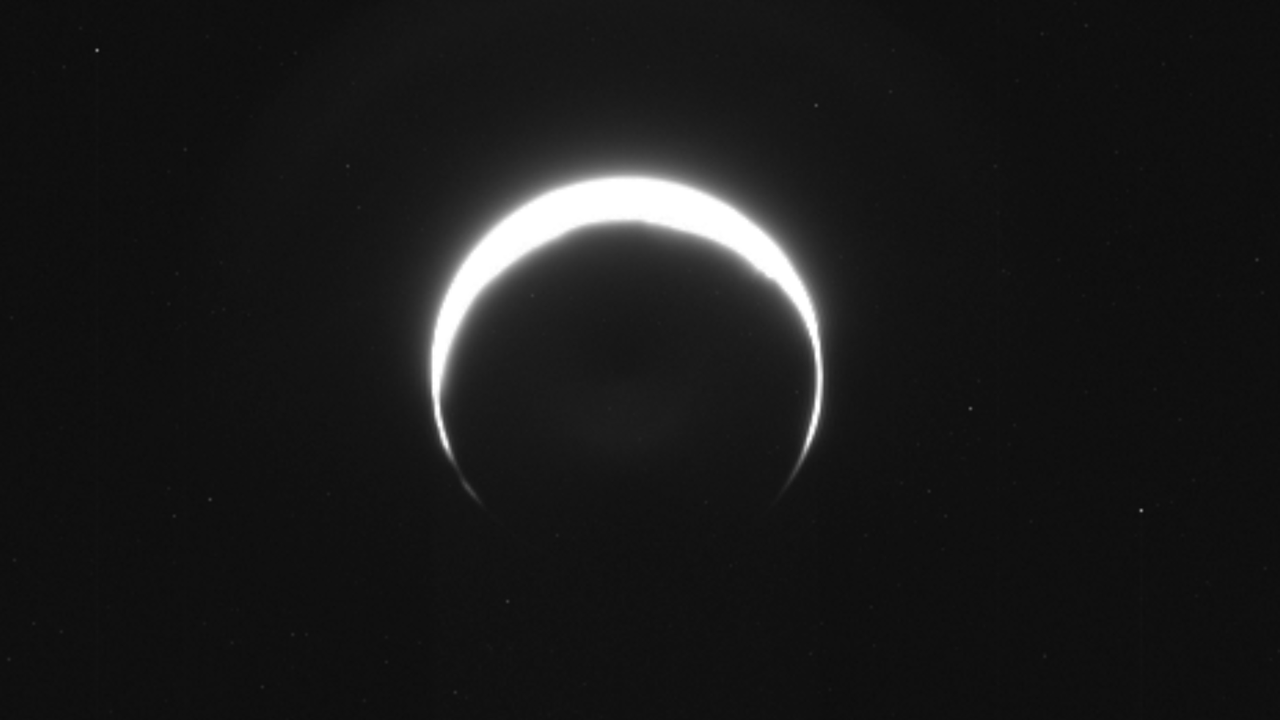
- Psyche probe snapped Mars image on May 14 during a flyby
- The photo looks like a solar eclipse but isn't one
- Psyche is heading to the asteroid 16 Psyche, not Mars
NASA’s Psyche spacecraft just returned a striking image of Mars that’s easy to mistake for a solar eclipse. The photo was taken on May 14 as the probe zipped past the red planet on its way to a metal-rich asteroid. What makes it confusing isn’t just the dark circle engulfing part of Mars—it’s that the image captures Mars against the backdrop of the solar system’s star. The effect mimics an eclipse, but there’s no moon involved. Psyche’s cameras were actually capturing part of Mars’ disk disappearing behind the probe’s own sunshade, creating a narrow-angle view that tricked a lot of eyes at first glance.
Why this photo isn’t a solar eclipse
A solar eclipse happens when the moon blocks the sun from Earth’s perspective. This photo doesn’t involve a moon or even Earth—it’s Mars, a planet, and a spacecraft with a sunshade acting like a tiny artificial horizon. The Psyche team later clarified that the image was part of a routine calibration sequence, not a scientific observation. Still, the result went viral because it looks so much like something it’s not. The photo was taken from about 20 million miles away from Mars, a distance that makes the planet appear small in the frame. The sunshade on Psyche’s camera system blocked part of Mars’ disk, leaving a crescent shape that’s reminiscent of an eclipse.
What Psyche was really doing near Mars
Psyche isn’t stopping at Mars—it’s using the planet’s gravity to slingshot toward its main target, the asteroid 16 Psyche. This metal-heavy asteroid, located in the outer part of the asteroid belt between Mars and Jupiter, is thought to be the exposed core of a failed planet. The spacecraft launched in October 2023 and is expected to arrive at 16 Psyche in 2029. The Mars flyby on May 14 was a critical navigation maneuver, giving Psyche the speed boost it needs to reach its destination. The probe’s primary mission is to study the asteroid’s composition, which could reveal clues about how planets like Earth formed.
How the image fooled so many people
The internet loves a good optical illusion, and this Mars photo delivered. On social media, the image spread fast with captions calling it an eclipse or joking about alien trickery. The confusion came down to perspective. From Psyche’s viewpoint, Mars was backlit by the sun, and the sunshade blocked part of the planet’s disk. The result was a crescent Mars that looked like it was being eclipsed. NASA’s own press release didn’t immediately clarify the mistake, which only added to the viral effect. The agency later confirmed the image was part of a camera test, not a scientific observation.
Why this matters beyond the memes
Beyond the wow factor, this photo highlights how spacecraft cameras are tested and calibrated before they reach their destinations. Psyche’s imaging system, called the Multispectral Imager, will eventually map the surface of 16 Psyche in detail. But before it gets there, the team needs to make sure the cameras are properly aligned and focused. The Mars flyby was a chance to test the imager in real conditions, even if the results were a little confusing to the public. The spacecraft’s other instruments, including a magnetometer and a gamma-ray spectrometer, were also checked during the flyby.
Looking ahead, Psyche still has a long journey. After its Mars gravity assist, the probe will spend the next five years traveling toward 16 Psyche. Once it arrives, it’ll spend at least 21 months orbiting and studying the asteroid. If the mission succeeds, it could rewrite what we know about planetary cores and the early solar system. For now, though, the internet’s obsession with a photo that isn’t what it seems shows how even space exploration can deliver surprises—and how easy it is to get tripped up by perspective.
What You Need to Know
- Source: Space.com
- Published: May 14, 2026 at 20:00 UTC
- Category: Science
- Topics: #space · #astronomy · #nasa · #science · #mars · #psyche
Read the Full Story
This is a curated summary. For the complete article, original data, quotes and full analysis:
All reporting rights belong to the respective author(s) at Space.com. GlobalBR News summarizes publicly available content to help readers discover the most relevant global news.
Curated by GlobalBR News · May 14, 2026
Related Articles
- 5 Ways to Vet Social Media Health Advice Before Trying It
- Your Body Clock May Enhance The Benefits of Exercise, Study Finds
- Study finds yawns contagious before birth, even more than thought
🇧🇷 Resumo em Português
Um registro feito pela sonda Psyche, da NASA, enquanto sobrevoava Marte, trouxe uma imagem que lembra um eclipse solar, mas que, na verdade, é um fenômeno óptico intrigante. A fotografia, tirada a milhões de quilômetros de distância, mostra a sombra da lua marciana Fobos cruzando a superfície do planeta vermelho, criando um efeito visual semelhante ao que observamos na Terra durante eclipses solares totais.
Esse tipo de imagem não apenas fascina os entusiastas do espaço, mas também oferece dados valiosos para a ciência planetária. Para o Brasil, que tem investido cada vez mais em pesquisas espaciais e colaborações internacionais, o registro reforça a importância de missões como a Psyche, que estudam asteroides e luas para compreender melhor a formação do Sistema Solar. Além disso, imagens como essa ajudam a popularizar a astronomia entre o público brasileiro, despertando interesse por ciência e tecnologia, áreas essenciais para o desenvolvimento do país.
Especialistas já planejam analisar mais dados da Psyche, que segue viagem rumo ao asteroide metálico de mesmo nome, prometendo descobertas que podem redefinir nosso entendimento sobre os primórdios do Sistema Solar.
🇪🇸 Resumen en Español
La nave Psyche de la NASA ha capturado desde el espacio un curioso fenómeno que evoca un eclipse de Marte, aunque con un giro inesperado. En lugar de oscurecerse, el planeta rojo aparece parcialmente velado por su luna Fobos, ofreciendo una imagen que desafía la percepción clásica de estos eventos astronómicos.
El registro, realizado a millones de kilómetros de distancia, no es un eclipse solar al uso, sino un tránsito de Fobos frente al Sol, un fenómeno cotidiano en el sistema marciano pero poco visto desde fuera de la órbita terrestre. Para los hispanohablantes, este hito subraya el avance de la exploración espacial y la capacidad tecnológica para observar el cosmos con detalle, además de recordar que, más allá de la Tierra, otros mundos también experimentan dinámicas celestes fascinantes. La imagen, difundida por la agencia espacial, no solo enriquece nuestro conocimiento de Marte, sino que inspira interés por la astronomía en comunidades de habla hispana con creciente acceso a la ciencia.
Space.com
Read full article at Space.com →This post is a curated summary. All rights belong to the original author(s) and Space.com.
Was this article helpful?


Discussion