London police manage 40,000 protesters in rival Tommy Robinson and pro-Palestinian marches Saturday without major clashes.
- Police deployed 4,000 officers to separate rival London marches Saturday
- Protesters included far-right activist Tommy Robinson supporters and pro-Palestinian groups
- No major incidents reported despite large crowds
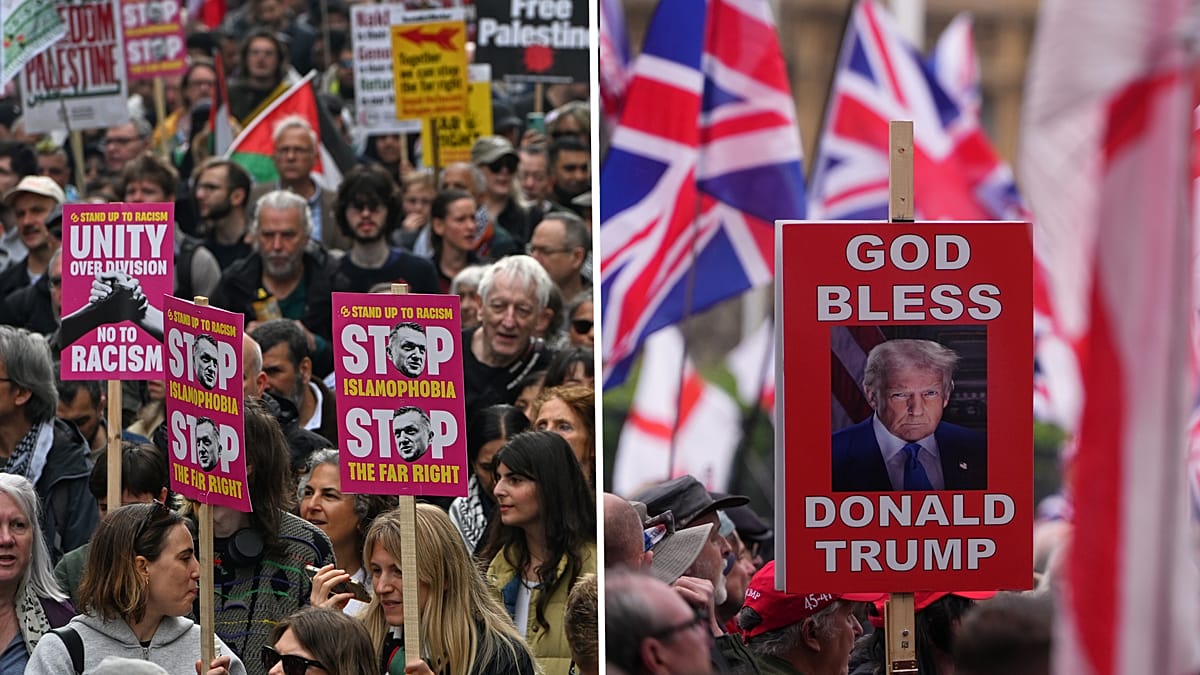
London police managed two massive rival demonstrations Saturday as far-right supporters of Tommy Robinson and pro-Palestinian activists marched through the capital. Authorities deployed 4,000 officers to enforce strict crowd control measures, including pre-approved routes, to prevent violent clashes between the estimated 40,000 total participants. No major incidents were reported by evening, though tensions remained high in central London areas near Parliament Square and Whitehall.
Crowds gather for competing causes
The demonstrations unfolded as thousands of Tommy Robinson backers marched from Hyde Park toward Parliament Square, waving flags and chanting slogans. Simultaneously, pro-Palestinian groups gathered in central London, demanding an immediate ceasefire in Gaza and criticizing Western governments’ support for Israel. Organizers for both events had secured permits weeks in advance, but police maintained tight control over movement and interaction between the two groups.
Police confirmed the deployment of 12 police helicopters, mounted units, and specialist public order teams to monitor the situation. Officers also used automated licence plate readers to track potential troublemakers approaching either march. Commander Ade Adelekan, the senior officer overseeing the operation, stated that while the demonstrations were legal, any attempt to breach peace would face immediate response.
Tensions flare at key intersections
Video footage showed sporadic shouting matches between small groups of protesters near Trafalgar Square, though no physical altercations were reported. Authorities had established exclusion zones around key landmarks, including Downing Street and the Houses of Parliament, to prevent either group from disrupting government functions. Businesses along planned march routes boarded up windows as a precaution, while public transport services experienced minor delays.
The Tommy Robinson march, organized by the English Defence League offshoot Britain First, focused on themes of immigration and national identity. Organizers claimed turnout exceeded 20,000, though police estimated closer to 15,000. Speakers at the event condemned what they described as ‘uncontrolled immigration’ and called for stricter border controls.
Pro-Palestinian demonstration draws large crowd
The pro-Palestinian march, led by groups including Palestine Solidarity Campaign, saw an estimated 25,000 participants according to organizers, with police placing the figure closer to 18,000. Demonstrators carried Palestinian flags and signs calling for an end to the war in Gaza, with many holding photos of civilians killed in the conflict. The route passed near the Israeli embassy in Kensington, where a heavy police presence remained throughout the day.
Police face scrutiny over crowd estimates
The discrepancy between organizer and police estimates of crowd sizes became a secondary point of contention on social media, with both sides accusing the other of inflating or minimizing figures for political purposes. Police defended their methodology, stating aerial surveys and real-time crowd density analysis were used to calculate numbers.
What happens next
Authorities have warned that further protests are likely in the coming weeks, with both sides organizing additional demonstrations. Police plan to review their operational response while maintaining high visibility in key areas. Meanwhile, community leaders in affected boroughs have called for calm and urged residents to avoid areas where protests are scheduled.
The events underscored ongoing divisions in British society over issues of immigration, foreign policy, and national identity. With general elections approaching, politicians across the spectrum are expected to address these topics in campaign messaging.
What You Need to Know
- Source: Euronews
- Published: May 16, 2026 at 16:46 UTC
- Category: World
- Topics: #euronews · #europe · #world-news · #london · #tommy-robinson · #palestinian
Read the Full Story
This is a curated summary. For the complete article, original data, quotes and full analysis:
All reporting rights belong to the respective author(s) at Euronews. GlobalBR News summarizes publicly available content to help readers discover the most relevant global news.
Curated by GlobalBR News · May 16, 2026
Related Articles
- Zimbabwe’s diaspora reshapes real estate and farming investment trends
- 🎉 250 Articles in World!
- Eurovision 2024 faces scrutiny over Israel’s participation amid war
🇧🇷 Resumo em Português
Em um fim de semana histórico, Londres virou palco de dois protestos massivos que, embora com causas distintas, se cruzaram em meio a uma tensão inédita nas ruas britânicas: enquanto 40 mil manifestantes se uniram em apoio ao ativista de extrema-direita Tommy Robinson, outros milhares marcharam pela causa palestina, forçando a polícia a mobilizar 4 mil agentes para evitar confrontos. A cena, que reuniu grupos com visões diametralmente opostas, expôs não só os limites da liberdade de expressão na Europa, mas também a crescente polarização social que ameaça a estabilidade política do continente.
No Brasil, onde a discussão sobre imigração, conflitos geopolíticos e o avanço da extrema-direita ganha cada vez mais espaço, a notícia serve como um alerta sobre os riscos de radicalização em sociedades plurais. A presença de Tommy Robinson, figura controversa ligada ao movimento anti-Islã e condenado por desrespeito à Justiça, evidencia como o discurso de ódio pode se institucionalizar mesmo em democracias consolidadas. Para o Brasil, que enfrenta desafios semelhantes — como a ascensão de grupos conservadores e a polarização em torno da política externa —, o episódio londrino reforça a importância de debater limites éticos e legais para a mobilização popular, sem cair na armadilha da censura ou do radicalismo.
A próxima semana promete novos desdobramentos, com autoridades britânicas avaliando se endurecem as leis contra discursos de ódio e com organizações de direitos humanos cobrando maior proteção às minorias. Enquanto isso, o mundo acompanha: até quando as sociedades conseguirão conviver com a diversidade sem que ela se transforme em confronto?
🇪🇸 Resumen en Español
Miles de manifestantes se enfrentaron en las calles de Londres este sábado, donde decenas de miles se congregaron para apoyar al polémico activista Tommy Robinson al tiempo que otros tantos reclamaban por Palestina, en un choque de posturas que puso a prueba la convivencia en la capital británica.
La tensión entre ambos grupos, separados por más de 400 agentes de policía, refleja el profundo división social que recorren Europa y Reino Unido, donde el auge de discursos polarizados —desde el ultranacionalismo hasta el activismo pro palestino— choca con los esfuerzos por mantener el orden público. Para los hispanohablantes, estos sucesos recuerdan los riesgos de la fractura social en sociedades multiculturales, un tema que resuena en países como España, donde el debate sobre identidad, migración y conflicto geopolítico también enfrenta a distintos sectores de la población.
Euronews
Read full article at Euronews →This post is a curated summary. All rights belong to the original author(s) and Euronews.
Was this article helpful?

Discussion