U.S. Navy disables two Iranian tankers attempting to bypass blockade near Strait of Hormuz.
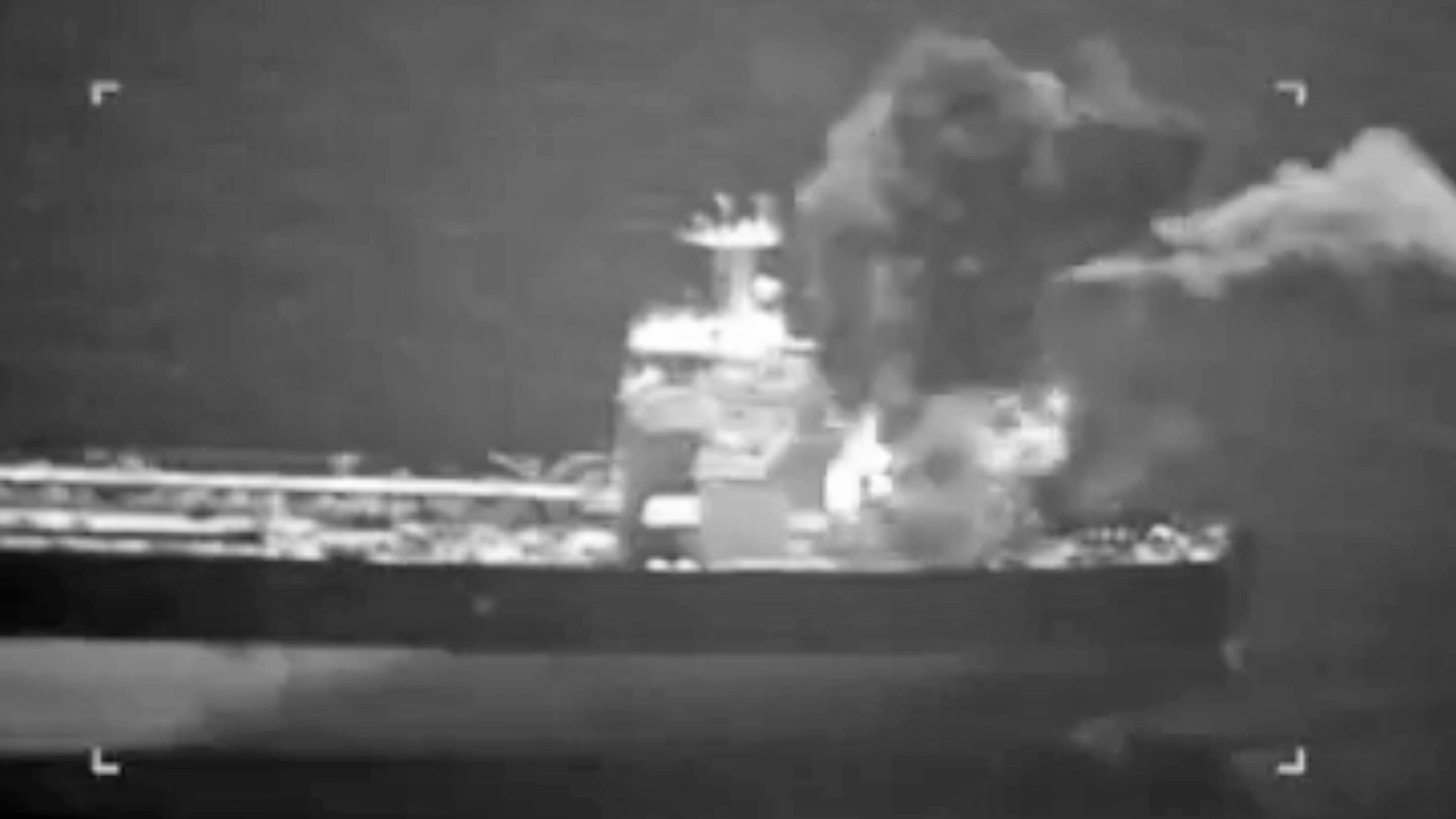
- U.S. Navy destroys two Iranian tankers violating blockade near Strait of Hormuz
- F/A-18 Super Hornet fired munitions into tankers' smokestacks before they reached Iran
- CENTCOM released video showing strikes on M/T Sea Star III and M/T Sevda
U.S. Central Command (CENTCOM) confirmed today that American forces disabled two Iranian oil tankers attempting to break a U.S. blockade near the Strait of Hormuz. The strikes targeted the M/T Sea Star III and M/T Sevda, both of which were stopped before entering an Iranian port in the Gulf of Oman. A U.S. Navy F/A-18 Super Hornet from the USS George H.W. Bush (CVN 77) fired precision munitions into the vessels’ smokestacks, rendering them inoperable and preventing their entry into Iran.
CENTCOM released video footage of the strikes, showing the moments before and after the aircraft targeted the tankers. The operation occurred amid escalating tensions in the region, with the U.S. and Iran exchanging fire earlier in and around the Strait of Hormuz. The Strait of Hormuz, a critical chokepoint for global oil shipments, has been a flashpoint for recent military confrontations between the two nations.
The UAE also reported another attack by Iran today, adding to the growing list of incidents in the region. This follows a pattern of Iranian aggression in the Gulf, including drone strikes and attempted seizures of commercial vessels. The U.S., which has maintained a naval presence to enforce its blockade, has warned Iran against violating international maritime laws.
Iran-U.S. tensions escalate in Strait of Hormuz
The latest strikes come just hours after the U.S. and Iran engaged in direct confrontations near the Strait of Hormuz, a vital shipping lane for global oil supplies. Iran has accused the U.S. of provoking tensions, while Washington has framed its actions as necessary to counter Iranian threats to regional stability. The Strait of Hormuz has seen multiple incidents in recent months, including drone attacks, missile strikes, and seizures of commercial ships by both sides.
CENTCOM stated that the targeted tankers were in violation of the U.S. blockade, which aims to prevent Iran from exporting oil in defiance of international sanctions. The agency emphasized that the strikes were conducted to enforce existing sanctions and maintain regional security. The operation reflects a broader U.S. strategy to counter Iranian maritime aggression and protect freedom of navigation in the Gulf.
International response to rising tensions
The international community has expressed concern over the escalating tensions in the Strait of Hormuz. The UAE, a key U.S. ally in the region, condemned Iran’s latest attack and reiterated its support for freedom of navigation. European nations have also urged restraint, emphasizing the need for diplomatic solutions to avoid further escalation.
Analysts warn that continued military confrontations could disrupt global oil supplies and destabilize the region. The Strait of Hormuz sees roughly 20% of the world’s oil pass through its waters daily, making it a critical economic artery. Any disruption could have far-reaching consequences for global energy markets and geopolitical stability.
The U.S. has not signaled plans for additional strikes but has warned Iran against further provocations. CENTCOM’s statement suggests that future actions will depend on Iran’s adherence to international maritime laws and its compliance with existing sanctions. Meanwhile, the UAE and other regional partners continue to monitor the situation closely as tensions remain high.
What You Need to Know
- Source: The Drive
- Published: May 09, 2026 at 00:15 UTC
- Category: War
- Topics: #military · #weapons · #conflict · #super-hornet-drops · #bombs-down-smokestacks · #iranian-tankers-running
Read the Full Story
This is a curated summary. For the complete article, original data, quotes and full analysis:
All reporting rights belong to the respective author(s) at The Drive. GlobalBR News summarizes publicly available content to help readers discover the most relevant global news.
Curated by GlobalBR News · May 09, 2026
Related Articles
🇧🇷 Resumo em Português
O ataque de um caça F/A-18 Super Hornet da Marinha dos EUA contra dois petroleiros iranianos no Estreito de Ormuz, filmado e divulgado pelo Comando Central (CENTCOM), expôs mais um capítulo tenso na guerra de nervos entre Washington e Teerã. As bombas lançadas não apenas danificaram os navios — usados, segundo fontes americanas, para burlar sanções —, mas também reacenderam o risco de um conflito direto na região mais estratégica do mundo para o petróleo.
O episódio ocorre em um cenário de crescente escalada, onde a livre navegação no Golfo Pérsico e no Estreito de Ormuz — por onde passa cerca de um terço do petróleo global — é constantemente ameaçada por ações de ambos os lados. Para o Brasil, que importa grande parte de seu combustível e mantém interesses comerciais na região, a instabilidade pode significar não só o aumento do preço dos combustíveis internamente, mas também a necessidade de reforçar a segurança de suas rotas marítimas no Oceano Atlântico e no entorno africano. A comunidade internacional, especialmente os países lusófonos com laços históricos ou econômicos no Golfo, observa com apreensão a possibilidade de uma resposta iraniana mais dura, que poderia fechar rotas críticas ou envolver aliados regionais.
Agora, resta saber se a Casa Branca optará por mais ações encobertas ou se a pressão diplomática será suficiente para esfriar os ânimos antes que a situação se torne incontrolável.
🇪🇸 Resumen en Español
El pasado viernes, un caza F/A-18 Super Hornet de la Armada estadounidense bombardeó dos petroleros iraníes en el Golfo de Omán, en un nuevo episodio de tensión que reaviva el pulso entre Washington y Teherán por el control de las rutas marítimas clave. Las imágenes difundidas por el Mando Central (CENTCOM) muestran el impacto de las bombas sobre las chimeneas de los buques, en una operación que el Pentágono justificó como respuesta a la “obstrucción” iraní a la libertad de navegación.
El incidente ocurre en un contexto de máxima volatilidad regional, donde el Estrecho de Ormuz —por el que transita un tercio del petróleo mundial— se ha convertido en un polvorín. Irán, que niega haber bloqueado buques, acusa a EE.UU. de provocaciones, mientras la comunidad internacional teme que la escalada derive en un conflicto abierto. Para los hispanohablantes vinculados al comercio energético o la seguridad marítima, este episodio subraya los riesgos de una crisis que podría encarecer el crudo y desestabilizar economías dependientes de las importaciones. La pregunta ahora es si ambas partes buscarán desescalar o, por el contrario, usarán este choque como argumento para reforzar sus posturas en el tablero geopolítico.
The Drive
Read full article at The Drive →This post is a curated summary. All rights belong to the original author(s) and The Drive.
Was this article helpful?


Discussion