2023 tropical rainforest loss slowed to 3.7 million hectares but El Niño fires threaten to reverse progress.
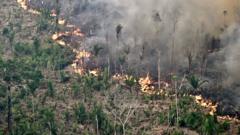
- Global tropical rainforest loss dropped 6% in 2023 to 3.7 million hectares
- El Niño weather patterns raise fire risks in vulnerable regions like the Amazon
- Conservation groups call for stronger protections to sustain progress
Global tropical rainforest loss slowed in 2023, with 3.7 million hectares destroyed—a 6% drop from the previous year, according to new satellite analysis by Global Forest Watch. The findings, released Thursday, mark the third consecutive year of declining deforestation rates, offering a rare bright spot in the fight against climate change and biodiversity loss. Still, experts caution that the progress remains fragile amid shifting weather patterns and economic pressures.
Scientists attribute the slowdown to expanded conservation efforts in key regions, including stricter enforcement in Brazil and Indonesia. Brazil, which accounted for nearly half of the global decline, saw a 50% reduction in Amazon deforestation under new federal policies aimed at curbing illegal logging. Indonesia, meanwhile, maintained its decade-long trend of reducing forest loss, driven by palm oil industry reforms and peatland protections.
El Niño risks reversing gains
But the gains could be short-lived. The developing El Niño weather pattern, expected to peak in late 2023 and early 2024, raises the risk of severe droughts and fires in tropical regions. The Amazon, already weakened by years of degradation, is particularly vulnerable. During the 2015-2016 El Niño, fires in the Brazilian Amazon destroyed over 1 million hectares of forest, reversing years of conservation work. “The risk is real,” said Dr. Frances Seymour, senior fellow at the World Resources Institute. “If El Niño intensifies, we could see a surge in deforestation that erases a decade of hard-won progress.”
Conservation groups are urging governments to bolster fire prevention measures and strengthen land-use policies before the dry season arrives. “We can’t afford to wait,” said José Gregorio Díaz Mirabal, international coordinator for the Coordinating Body of Indigenous Organizations of the Amazon Basin. “Indigenous communities need support to protect their territories, which are often the last line of defense against illegal logging and mining.”
Economic pressures threaten forests
Despite the progress, economic factors continue to drive deforestation in some regions. In Democratic Republic of Congo, mining and agricultural expansion pushed forest loss up 7% last year. The country, home to the world’s second-largest tropical rainforest, faces mounting pressure from global demand for cobalt and palm oil. “Economic incentives are still skewed toward exploitation,” said Tasso Azevedo, a forest policy expert. “Without economic alternatives, local communities will keep clearing land.”
What’s next?
The next 12 months will be critical in determining whether the slowdown in deforestation becomes a lasting trend or a temporary blip. Governments, corporations, and Indigenous groups are expected to ramp up conservation efforts ahead of the 2024 United Nations Climate Change Conference, where forest protection will be a key agenda item. “The window to act is narrow,” said Dr. Seymour. “We either build on this progress or risk losing it all to the next big fire season.”
What You Need to Know
- Source: BBC News
- Published: April 29, 2026 at 13:26 UTC
- Category: Environment
- Topics: #bbc · #environment · #climate · #war · #conflict · #tropical-rainforest-loss-2023
Read the Full Story
This is a curated summary. For the complete article, original data, quotes and full analysis:
All reporting rights belong to the respective author(s) at BBC News. GlobalBR News summarizes publicly available content to help readers discover the most relevant global news.
Curated by GlobalBR News · April 29, 2026
🇧🇷 Resumo em Português
O Brasil respirou aliviado em 2023 com a redução no desmatamento das florestas tropicais, mas o alívio pode ser temporário: o fenômeno El Niño, que já castiga o país com secas prolongadas, ameaça reverter os avanços com um novo ciclo de queimadas e derrubadas, colocando em risco ecossistemas vitais e o futuro do clima global.
Segundo dados recentes, a perda de cobertura florestal nos trópicos caiu em relação aos anos anteriores, sinalizando que políticas de fiscalização e pressão internacional podem estar surtindo efeito. No entanto, o Brasil — maior detentor da Floresta Amazônica — segue na linha de frente dessa batalha, especialmente agora que o El Niño intensifica a estiagem na região, tornando as florestas mais vulneráveis ao fogo. A situação é crítica: além de liberar milhões de toneladas de CO₂, o agravamento do desmatamento pode colocar em xeque metas climáticas e acordos internacionais, como o Acordo de Paris, que dependem da preservação desses biomas.
O próximo passo será monitorar de perto a Amazônia nos próximos meses, quando os impactos do El Niño devem atingir seu pico, exigindo ações coordenadas entre governos, ONGs e comunidades locais para evitar um retrocesso ambiental sem precedentes.
BBC News
Read full article at BBC News →This post is a curated summary. All rights belong to the original author(s) and BBC News.
Was this article helpful?



Discussion