NASA's Psyche spacecraft will slingshot past Mars on May 15 to gain speed for its trip to a metal asteroid.
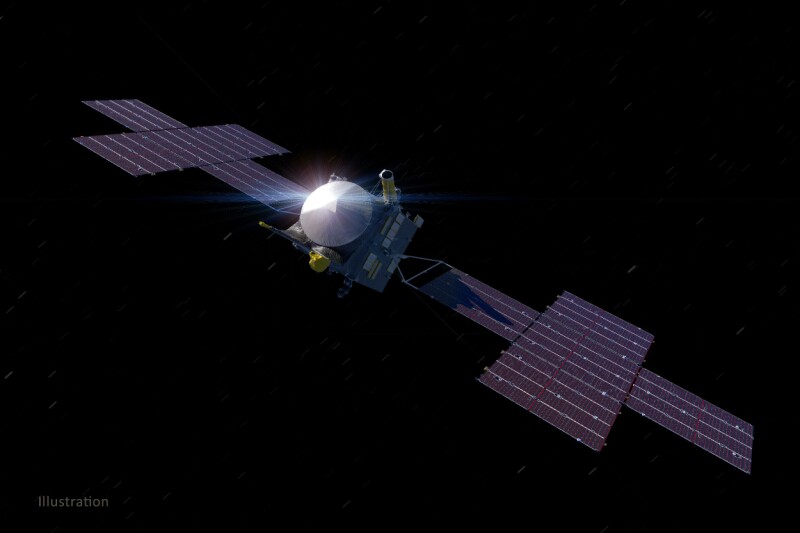
- Psyche will pass 2,800 miles above Mars at 19,848 kph on May 15
- The gravity assist will speed up the spacecraft for its 2029 asteroid rendezvous
- Scientists will confirm the new trajectory using Doppler shift measurements
NASA’s $1.2 billion Psyche mission is about to pull off one of its riskiest moves yet. At 7:21 a.m. ET on May 15, the spacecraft will hurtle past Mars, just 2,800 miles above the planet’s rust-colored surface. Moving at 19,848 kilometers per hour, the probe will use Mars’ gravity like a slingshot to pick up extra speed on its seven-year journey to the metal-rich asteroid 16 Psyche. This type of gravity assist isn’t new—NASA’s Mariner probes used it in the 1960s—but Psyche’s timing is tight. A two-year delay in launch forced the team to recalculate the flyby after the original 2022 window vanished due to software issues. Now, every second counts. The spacecraft’s arrival at Psyche is locked in for August 2029, so this burn has to work perfectly. If it misses, the mission risks missing its window entirely, leaving Psyche drifting in the wrong orbit for years. The team burned the spacecraft’s thrusters for 12 hours in February to fine-tune the approach. That burn nudged Psyche’s path just enough to set up this close pass. But the real confirmation won’t come until the Doppler shift in the probe’s signals changes as it flies by Mars. That shift will tell controllers exactly how much extra speed the planet gave Psyche—and whether they’re still on track for a 2029 arrival. Without this assist, Psyche would’ve needed far more fuel to reach its target, cutting its science mission short. The asteroid is special: it’s thought to be the exposed core of a failed planet, made mostly of nickel and iron. If Psyche’s instruments confirm that, it could rewrite what we know about how planets form. The spacecraft is packed with a gamma-ray spectrometer, a magnetometer, and a multispectral imager to study the asteroid’s composition and structure. But none of that matters if the gravity assist fails. The team at NASA’s Jet Propulsion Laboratory in California has practiced this maneuver in simulations for years. Still, there’s no room for error. Mars’ gravity will bend Psyche’s path by about 15 degrees, flinging it toward the asteroid belt. Ground stations in Madrid and Goldstone will monitor the probe’s signals in real time, hunting for the telltale Doppler shift that confirms the assist worked. If all goes well, Psyche will coast for another four years before entering orbit around the asteroid. The mission’s primary science phase will last 21 months, giving researchers their first close-up look at a metallic world. But even if the flyby succeeds, the probe’s journey isn’t over. After reaching Psyche, it’ll need to slow down and match the asteroid’s orbit—a delicate dance that requires precise calculations. Any misstep could send the spacecraft past its target or into a collision course. For now, the team is focused on May 15. They’ve got one shot to get this right. If Psyche misses the assist, the mission would need a costly redesign to reach its destination later—assuming another window opens at all. That’s why this flyby matters more than most. It’s not just a speed boost. It’s the difference between a smooth science mission and years of delays.
What You Need to Know
- Source: The Register
- Published: May 15, 2026 at 14:09 UTC
- Category: Technology
- Topics: #theregister · #tech · #enterprise · #science · #space · #nasa
Read the Full Story
This is a curated summary. For the complete article, original data, quotes and full analysis:
All reporting rights belong to the respective author(s) at The Register. GlobalBR News summarizes publicly available content to help readers discover the most relevant global news.
Curated by GlobalBR News · May 15, 2026
Related Articles
- XS 1.2.26: A single binary that runs anywhere, no runtime needed
- Sam Altman’s trust on trial as Elon Musk sues OpenAI
- Wanted: Digital chief for England’s schools. Must enjoy data, AI, and concrete problems
🇧🇷 Resumo em Português
A sonda Psyche, da NASA, está prestes a realizar um sobrevoo histórico por Marte em 15 de maio, uma manobra ousada que promete impulsionar a missão em direção ao asteroide metálico Psyche, um dos objetos mais intrigantes do sistema solar. A aproximação máxima, a apenas 2,8 mil milhas (cerca de 4,5 mil km) da superfície marciana, será crucial para a trajetória da sonda, que aproveitará a gravidade do planeta para ganhar velocidade e ajustar sua rota rumo ao seu destino final.
O sobrevoo não apenas representa um feito técnico para a NASA, mas também desperta interesse no Brasil e entre os falantes de português, especialmente pela crescente participação do país em missões espaciais e pela relevância da exploração de asteroides para a ciência. O Brasil tem avançado em seu programa espacial, com parcerias internacionais e desenvolvimentos próprios, como o foguete VLM e a participação em missões como a Garatéa-L, que estudam a viabilidade de exploração lunar. Além disso, asteroides como o Psyche, composto majoritariamente de metal, podem oferecer pistas sobre a formação do sistema solar e até sobre a origem da Terra, temas que ressoam na comunidade científica lusófona.
Se a manobra for bem-sucedida, a Psyche estará a caminho de seu encontro com o asteroide em 2029, após uma viagem de cinco anos, reafirmando a importância das missões de assistência gravitacional para a exploração espacial.
🇪🇸 Resumen en Español
La sonda Psyche de la NASA se prepara para un sobrevuelo histórico cerca de Marte el próximo 15 de mayo, un giro arriesgado que podría definir el rumbo de su viaje hacia el enigmático asteroide metálico del mismo nombre. Este encuentro fugaz, a solo 4.500 kilómetros de la superficie marciana, no solo servirá para ajustar su trayectoria mediante un efecto honda gravitacional, sino que también ofrecerá una oportunidad única para calibrar instrumentos y recopilar datos científicos inéditos.
El éxito de esta maniobra es clave para que Psyche alcance su destino en 2029, un viaje de más de 3.500 millones de kilómetros que busca desentrañar los misterios de los núcleos planetarios, ya que el asteroide parece ser el corazón expuesto de un protoplaneta destruido. Para los hispanohablantes, este hito tecnológico no solo refuerza el liderazgo de la NASA en la exploración espacial, sino que también subraya la importancia de la colaboración internacional en misiones de larga distancia, un recordatorio de que el cosmos sigue siendo un campo de estudio accesible y fascinante para todos.
The Register
Read full article at The Register →This post is a curated summary. All rights belong to the original author(s) and The Register.
Was this article helpful?



Discussion